

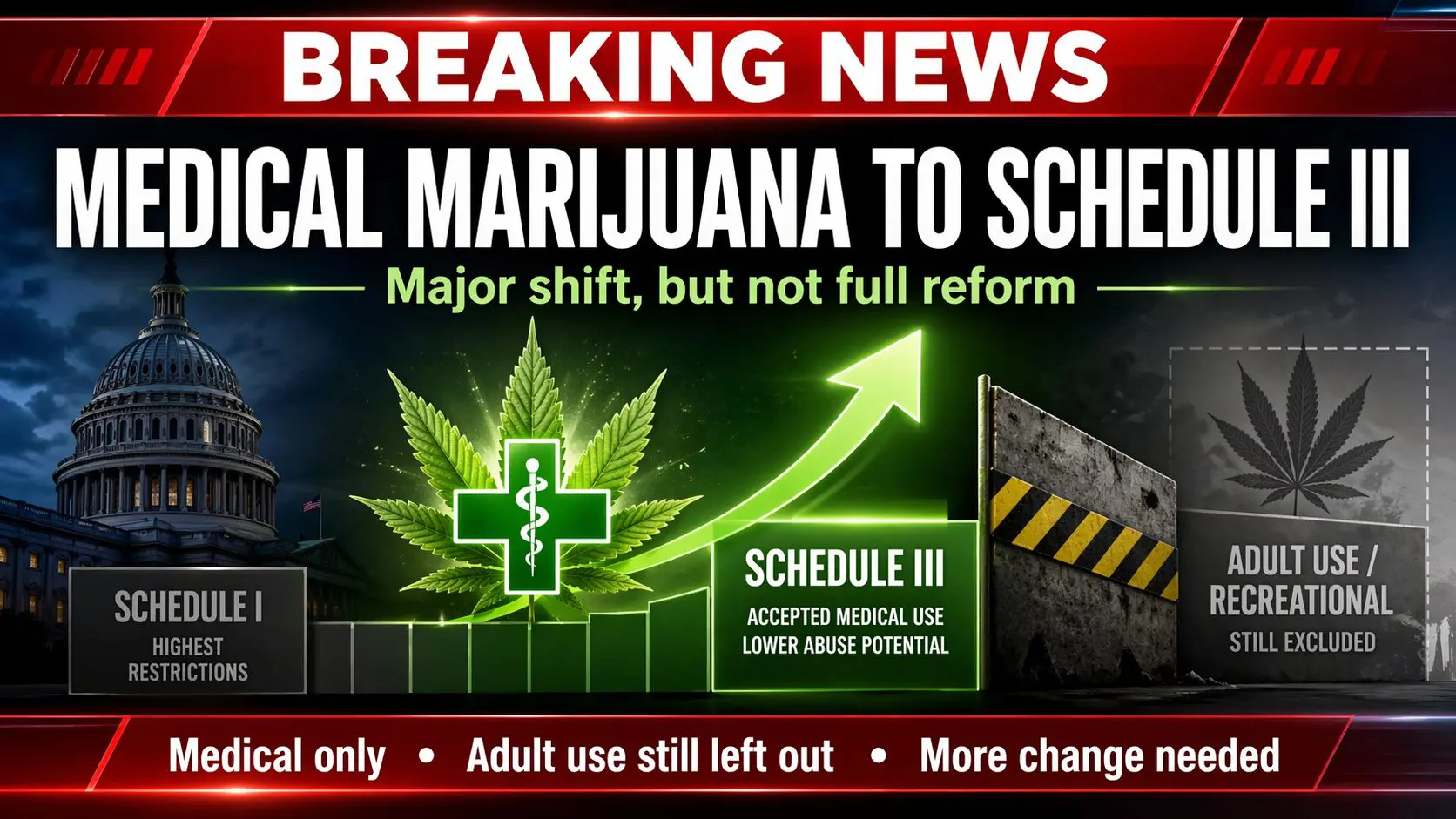
FDA-Approved and State-Licensed Products Are Moved to Schedule III
The biggest day in federal cannabis policy in decades arrived this morning — and the fine print is doing a lot of work.
For years, cannabis advocates, industry operators, and policy watchers have dreamed of the day the federal government would move marijuana off Schedule I — off the shelf it shares with heroin, away from the company of substances deemed to have no accepted medical use and a high potential for abuse. Today, April 23, 2026, that day arrived. Acting Attorney General Todd Blanche signed the order. The DEA made it official. Cannabis, in limited form, is now a Schedule III controlled substance under federal law.
Savor the moment for a breath, and then read the fine print.
What moved to Schedule III is not cannabis as a category. It is not hemp-derived THC. It is not the THCA flower sitting in the case at your neighborhood smoke shop. It is not recreational marijuana, not CBD gummies, not delta-8 cartridges, not a single product in the vast and inventive gray market that has operated under the protective ambiguity of the 2018 Farm Bill. What moved to Schedule III is a carefully circumscribed set of products: FDA-approved drug formulations containing delta-9-THC derived from Cannabis sativa L., and marijuana subject to a qualifying state-issued medical marijuana license.
That’s it. That’s the win.
Everything else — and there is a great deal of everything else — remains Schedule I. Any marijuana product that is neither FDA-approved nor covered by a state medical license is still, under federal law, as illegal today as it was yesterday. The DOJ press release phrases this with lawyerly precision: the order applies to products “subject to a qualifying state-issued license authorizing the licensee to manufacture, distribute, and/or dispense marijuana or products containing marijuana for medical purposes.” The recreational market in legal states? Still Schedule I. The hemp-derived THC products that have carved out a multi-billion dollar niche in the regulatory gray zone? Still Schedule I. Still, potentially, federal felonies.
This distinction is not incidental. It is the architecture.
To understand why, you have to appreciate who benefits from today’s order and who does not. The clear winners are the multi-state operators — the MSOs that have spent years building licensed, regulated, vertically integrated cannabis businesses in states that permit medical use. These companies have labored under Section 280E of the Internal Revenue Code, a provision that denies standard business deductions to enterprises trafficking in Schedule I or II substances. Moving to Schedule III eliminates that burden, potentially freeing up tens of millions of dollars in annual tax liability for the larger operators. It also accelerates federally permitted research, clears a path for banking relationships long denied to Schedule I businesses, and, less tangibly but not insignificantly, removes some portion of the stigma that has clung to the industry like smoke to fabric.
The losers are the hemp-derived THC operators — the manufacturers, distributors, and retailers who have built businesses on the premise that Farm Bill hemp, with its permissive treatment of cannabinoids other than delta-9, created a lawful pathway to the intoxicating cannabis market. Today’s order does not validate their business model. If anything, it sharpens the line of demarcation between the licensed, legitimate cannabis industry and what the MSOs have long called the gray market — and have more recently started calling an unlawful competitor.
Consider the sequence. For the past two years, multi-state operators have been suing smoke shops and distributors across the country — in Missouri, Pennsylvania, and Texas among other states — arguing that hemp-derived THCA products are functionally marijuana and should never have been sold under Farm Bill cover. Today’s rescheduling order hands those operators a cleaner rhetorical weapon. If you want the protection of federal tolerance, get a state medical license. If you don’t have one, the federal government has just made its position more explicit, not less.
The order was signed by Todd Blanche, the acting attorney general, and it comes roughly four months after President Trump’s executive order directing the administration to move forward on rescheduling — a process that had languished through years of NPRM proceedings, administrative hearings, and public comment periods under the previous administration. That the Trump DOJ completed the move, however narrowly scoped, is genuinely notable. It is not the comprehensive reform that advocates sought, but it is a real policy change with real economic consequences for a real industry.
The next inflection point is June 29, 2026, when the DEA has announced it will convene an expedited hearing to consider whether marijuana as a category — not just the FDA-approved and state-licensed subset — should be reclassified to Schedule III as well. That hearing is where the broader argument will be fought. It is where the hemp industry will have to confront the question it has largely avoided: if marijuana moves to Schedule III wholesale, does the Farm Bill gray zone collapse entirely, or does it survive through a different legal theory?
No one has a clean answer to that question yet, which is precisely why it’s the most important question in cannabis policy right now.
What we know today is this: the federal government drew a line, and it drew that line around the licensed medical market. THCA is on the wrong side of it. Hemp-derived intoxicants are on the wrong side of it. The gray market — creative, entrepreneurial, constitutionally interesting, and genuinely beloved by the consumers it serves — just got a clearer target on its back.
That’s not a reason to despair. It’s a reason to pay very close attention to what happens on June 29.
Jay Maguire covers cannabis policy, hemp industry litigation, and the politics of drug reform. He is political editor of a cannabis industry trade publication and an investigator working on behalf of hemp retailers and distributors in regulatory and legal proceedings.
