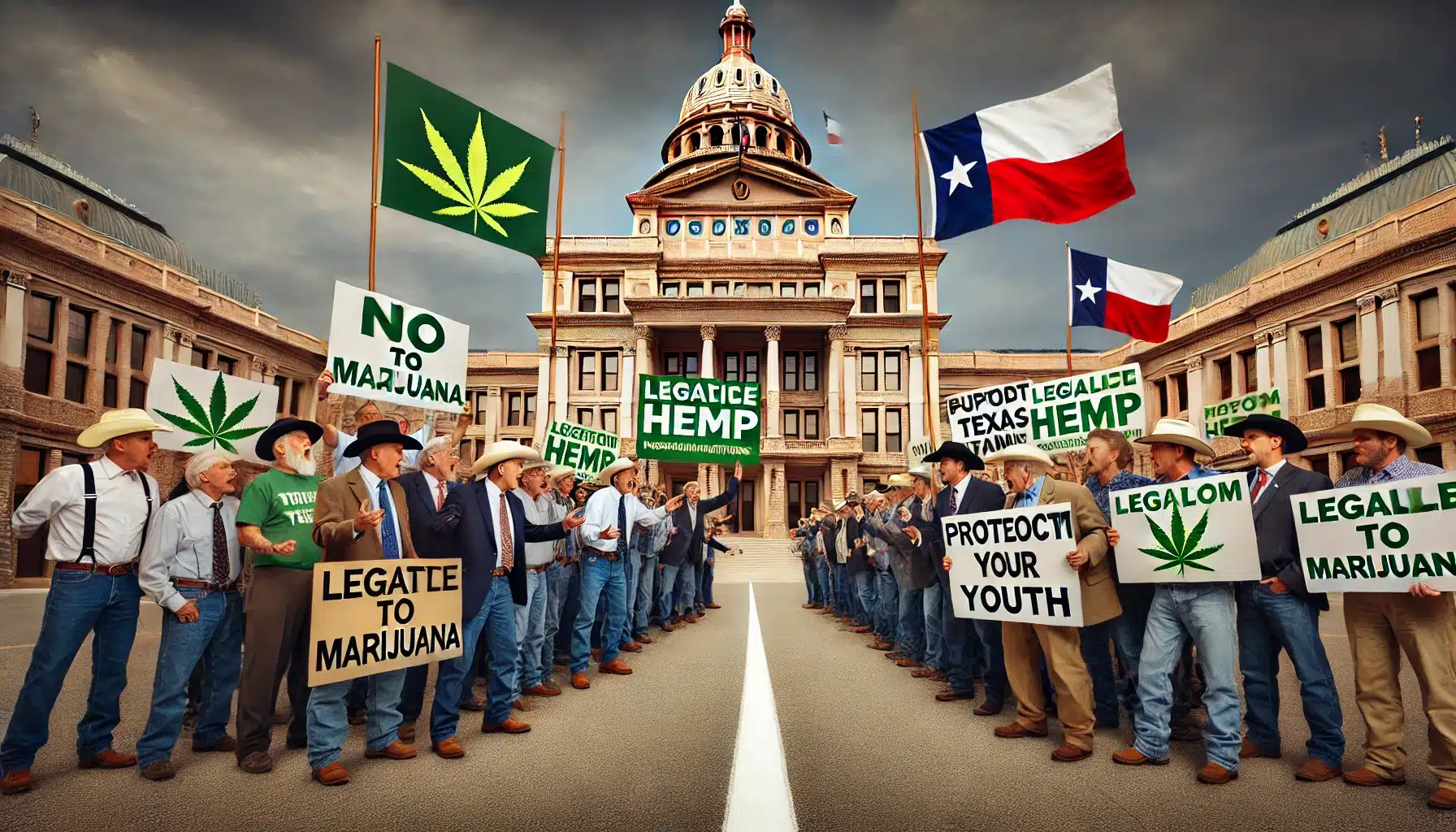
Lt. Governor Dan Patrick is selling Texans a fraud—and calling it reform. Senate Bill 3, his signature attempt to ban nearly all hemp-derived THC products, is nothing short of a full-spectrum assault on personal liberty, small business, patient access, and constitutional rights. With a straight face and a white coat, Patrick is using the language of public health to disguise what is ultimately a prohibitionist power grab.
Governor Abbott must veto SB 3. Here’s why:
1. They’re Coming for Your Guns, Not Just Your Gummies
When a Texan signs up for medical cannabis through TCUP, they’re unknowingly walking into a legal buzzsaw. Overnight, they become a “prohibited person” under federal law—no firearms, no ammo, no recourse. This isn’t some bureaucratic technicality. It’s disarmament disguised as medicine. And Dan Patrick knows damn well what it means. He’s banking on Texans not reading the fine print.
2. They’re Yanking Relief Right Off the Shelf
For years, Texans have had legal access to over-the-counter hemp products like Delta-8 and Delta-9. These products have helped veterans sleep, cancer patients eat, and working folks manage stress without jumping through hoops. SB 3 would rip those remedies off the shelves and toss them in the trash, forcing everyone into a system they neither asked for nor need.
3. They Shut Down the Corner Store and Opened a Toll Booth
With SB 3 outlawing OTC hemp and forcing patients into TCUP, Patrick’s plan funnels every Texan into a tightly controlled, DPS-operated monopoly. The state isn’t offering medicine—it’s charging admission. And only a select few companies, cozy with the Capitol crowd, get to collect the toll.
4. They’re Pricing Pain Relief Like It’s Platinum
Once they’ve shut down your neighborhood shop, they’ll send you to a DPS-licensed dispensary where the price tag is as steep as the red tape. Insurance won’t cover a drop, and the product selection is as sparse as a West Texas rainstorm. The folks who need it most—veterans, seniors, and working-class Texans—are left high and dry.
5. They’ll Nail You Whether You Tell the Truth or Not
Want to follow the law? Tell the ATF you’re a TCUP patient—and kiss your gun rights goodbye. Want to keep your rifle? Lie on the form—and risk a felony. Patrick’s “compassionate” policy is a legal booby trap, rigged to criminalize honest Texans either way.
6. They’re Using Junk Science to Kick in Your Door
Patrick’s DPS has been storming small businesses using discredited lab tests and manipulated data. The Texas Forensic Science Commission warned against it—three times. But instead of fixing the problem, Patrick leaned into it, letting politics override science to justify sweeping raids. That ain’t law enforcement—it’s showbiz with badges.
7. They’re Letting Their Buddies Cash In Behind Closed Doors
Under the new TCUP rules, investors can stay anonymous. That means lobbyists, donors, and political cronies can rake in the profits while Texans lose access, lose jobs, and lose everything they’ve built. It’s medicine for the rich and raids for the rest.
8. They’re Crying Wolf While Texans Suffer
Patrick stood on the Senate floor waving horror stories about vomiting, psychosis, and panic attacks. But the facts tell a different tale. These so-called dangers are rare, extreme, and usually tied to long-term heavy use. Meanwhile, Tylenol and Imodium cause more ER visits than cannabinoids ever have. It’s classic Patrick: distract, distort, and divide.
—
The Verdict: Texans Are Getting Played, Not Protected
They’re losing their guns, their medicine, their freedom to choose, and their right to run a business—all so Patrick and his allies can consolidate power, control markets, and cloak prohibition in the language of compassion.
This bill is a lie wrapped in a lab coat and tied with campaign cash.
Governor Abbott: Veto SB 3. Texans see the game. Don’t play.
Lieutenant Governor Dan Patrick has made banning hemp-derived THC products a top priority this session, even threatening a special session if the House refused to advance the measure. Senate Bill 3, which passed the House after heavy procedural pressure, would effectively shut down Texas’ entire market for legal, consumable hemp products. But two recent polls—one from UT Austin and another from the Texas Hemp Business Council—tell the same story: most Texans don’t support this ban. And more notably, neither do most Republican voters.
The Texas Politics Project at the University of Texas at Austin found in April that a full 50% of Texans oppose outlawing cannabis-derived products, including hemp-based THC. Just 34% support such a move. And when voters were asked to rank the importance of various legislative priorities, placing limits on cannabis access came in near the bottom—15th out of 17.
Now, new June polling from Ragnar Research on behalf of the Texas Hemp Business Council drills into Republican primary voters specifically. The findings challenge the assumption that a THC ban plays well with the GOP base:
Just 35% of likely Republican primary voters support banning THC. 45% oppose.
On banning consumable hemp products, support and opposition are similarly split: 37% support vs. 47% oppose.
Among Republicans who align with Donald Trump, opposition to the ban grows: 47% oppose; 38% support.
72% of Republican voters say veterans should be allowed to access THC products as a non-opioid treatment option.
68% want law enforcement focused on violent crime and border security—not adults using legal hemp.
Perhaps most revealing, majorities also believe the policy itself is counterproductive: 53% agree a THC ban would create opportunities for drug cartels, and 55% say it would lead to more unregulated and dangerous synthetic products on the market.
So why is this prohibition moving forward? Why is Texas advancing a bill that’s unpopular even with Republican voters?
The answer lies not in the data—but in the dynamics of Texas politics.
Patrick has long shown a talent for mobilizing the most ideologically committed conservative voters in Republican primaries. These voters—often older, rural, and socially conservative—don’t constitute a majority, but they reliably turn out in low-participation primaries. And that turnout reality gives them disproportionate influence over Republican lawmakers, many of whom fear a challenge from their right more than any general election.
Even among these voters, the polling shows growing ambivalence toward prohibition. Just 31% of self-identified “extremely conservative” Republicans say marijuana should be completely illegal—down from 39% in 2010. Support for medical-only use and strict regulation continues to grow, even as public opinion shifts away from zero-tolerance approaches.
Yet Patrick is doubling down. Not because the policy is popular. But because the political calculus is familiar: cater to the base, use procedural leverage to force the House to comply, and count on silence from the Governor’s Mansion.
Governor Abbott has yet to take a clear position on SB 3. But he should consider the broader picture. There’s no groundswell for this bill. Its most persuasive arguments—protecting children, ensuring safety—could be achieved through regulation. Instead, a full ban would wipe out a legal industry, harm veterans seeking non-opioid therapies, and push consumers into unregulated gray markets.
More and more Texans—including Republican voters—see this for what it is: an overcorrection driven by political positioning, not public demand.
Texas doesn’t need to criminalize hemp to fix it. We need to regulate it with clarity, consistency, and respect for the law-abiding adults who use it—and the veterans whose quality of life depends on it.
A veto of SB 3 wouldn’t just correct a policy mistake. It would send a message: that governing in Texas still means listening to the people.
Dan Patrick’s Political Theater Has Real Victims—and Texans Are Paying the Price.
SB 2024: The Vape Bait-and-Switch
Sold as a defense against youth vaping, SB 2024 instead criminalizes flavored disposable vape products made in China or not FDA-authorized—effectively banning almost all available products in Texas. No grace period. No inventory relief. No respect for small retailers.
But global manufacturers shifted production months ago to Vietnam, Indonesia, and Malaysia. The “China ban” doesn’t block supply—it just cripples Texas retailers, while larger players quietly retool abroad.
Meanwhile, the packaging provisions are so vague and subjective that enforcement will depend entirely on perception, not fact. This creates a legal gray zone ripe for selective prosecution and abuse—with consequences borne disproportionately by minority-owned businesses and communities already over-policed.
A Blow to Liberty—and the Truth
What do you get when you pair bad science with political ambition, amplify it through law enforcement spectacle, and suppress the only agency qualified to call it out?
You get SB 3 and SB 2024.
You get a government that requires untrained officers to make felony arrests based on inaccurate lab results. You get “probable cause” traffic stops based on smell, suspicion, and outdated testing methods—the very ingredients that have driven racial disparities in policing for decades. You get executive overreach disguised as legislative prudence. You get governance by grievance, not by principle.
Dan Patrick plays MAGA, but his playbook is from the swampiest parts of the Deep State playbook: manufacture a threat, consolidate authority, and eliminate competition—then wrap it in MAGA red.
Texas Values Demand Better
Texas lawmakers have long claimed they don’t want to “pick winners and losers”—that they believe in free markets and level playing fields. But Dan Patrick turns that principle on its head. With bills like SB 3 and SB 2024, he handpicks the winners, criminalizes the rest, and blames the casualties on “the children.”
Texas values demand something better. We demand cannabis policy built on science, not superstition. We demand regulatory oversight from independent experts—not puppet labs with a financial stake in every conviction. We demand a free market—not a rigged cartel. And we demand leaders who tell the truth—not ones who choreograph its suppression.
Dan Patrick’s final act may be complete—but the damage is ongoing. Businesses are being raided. Lives upended. Patients are being abandoned. And trust in Texas government is being shredded for the sake of applause lines and power plays.
The show is just about over. The consequences are just beginning.
WARNING: THE REPORT DAN PATRICK DOESN’T WANT YOU TO SEE!
In Texas, we’ve seen this before: a political agenda dressed up as public safety, a compliant bureaucracy, and the weaponization of bad science to justify bad law. But this time, it’s not marijuana. It’s legal hemp—and the state’s own forensic watchdog warned them not to do it.
The Science Was Clear
In July 2021, the Texas Forensic Science Commission (FSC) issued a report questioning the reliability of gas chromatography (GC) testing methods—specifically the kind used by Armstrong Forensic Laboratory—in determining THC levels in cannabis samples. The problem? GC destroys the chemical integrity of the sample by heating it, converting non-psychoactive THCa into delta-9 THC. The result: legal hemp often appears “hot” when tested this way.
By April 2025, the Commission had grown more urgent. In a formal warning, it told prosecutors and law enforcement not to rely on GC-MS without derivatization—the exact method Armstrong was using—because it does not distinguish between THCa and delta-9 THC in processed products like vape pens and edibles. The Commission’s position was clear: GC is not scientifically valid for the enforcement of Texas hemp laws. The right tool? High-performance liquid chromatography (HPLC), which preserves the cannabinoid profile without artificially inflating THC levels.
DPS Didn’t Just Ignore the Science—They Sought Out Bad Results
Despite having access to state-run, accredited labs that used validated HPLC methods, the Texas Department of Public Safety (DPS) chose Armstrong Labs. Why? Because Armstrong’s flawed GC testing produced the kind of “hot” results that could turn lawful retail inventory into felony contraband on paper.
This wasn’t just negligence—it was selective science-shopping. DPS bypassed better labs and used the one that would give them the numbers needed to justify search and arrest warrants. Those warrants led to a coordinated series of raids in August 2024 across North Texas, most prominently in Allen, where nine hemp retailers—nearly all minority-owned—were raided. Doors were kicked in. Products were seized. People were arrested. Lives were disrupted.
And when asked about the scientific controversy, DEA Special Agent Eduardo A. Chávez, standing behind a row of local police chiefs, said the quiet part out loud:
“We’re not going to get into a scientific debate.”
That’s because there was no debate. The science was already settled—just not in their favor.
Dan Patrick’s Fingerprints
The timing and utility of these raids are no coincidence. Lt. Governor Dan Patrick, a long-time prohibitionist, has made clear his desire to eliminate the hemp-derived THC market. Along with Senator Charles Perry, he introduced Senate Bill 3, a sweeping measure to criminalize and regulate hemp in ways that would effectively shut down thousands of small businesses statewide.
But Patrick’s proposals needed fuel—a sense of public danger. That’s where the Allen raids came in. News coverage of the raids, complete with sensational claims about high-THC products and cash seizures, created the illusion of widespread criminality. Those raids—and the test results behind them—became Exhibit A in the Senate’s push for SB 3.
In reality, the entire operation was built on sand. The lab method was known to be invalid. The warrants were based on forensically unsound evidence. The prosecutions have largely stalled or gone unfiled. But the political damage was done—and the policy momentum created by those raids is still being used to push bans, criminal penalties, and massive regulatory overreach.
The Consequences
Dozens of stores have closed. Millions in assets have been seized. Texas entrepreneurs—many from immigrant and minority communities—have been branded criminals for selling federally legal hemp products. Some of the retailers caught in this net can’t even afford legal counsel; their bank accounts are frozen, their reputations destroyed.
All because DPS chose the wrong lab on purpose.
If It’s Not Illegal, It’s Worse
Some may argue no laws were broken. But that’s the problem. When law enforcement uses scientifically invalid methods, even after being formally warned twice by the state’s own scientific authority, it isn’t just a technical error. It’s an abuse of power. Under Texas Penal Code §39.03, this pattern begins to resemble official oppression—public servants using their authority to target people unjustly under the color of law.
And the Fourth Amendment may also come into play. Raids based on scientifically discredited probable cause are ripe for constitutional challenge. The state didn’t just bend the law—it bent science, and it bent justice.
The Big Lie, Texas Edition
Dan Patrick’s prohibitionist crusade depends on the belief that hemp stores are fronts for drug dealers. But the science doesn’t support that claim, and neither do the facts. What we’re seeing is the deliberate manufacture of criminality using rigged lab results and coordinated enforcement—all to push a bill that benefits entrenched political allies and clears the market for the few operators who can afford to comply.
This is Reefer Madness 2.0—driven by bad labs, bad busts, and big lies.
By Nicholas Mortillaro, and Jay Maguire Co-Founders, CRAFT (Cannabis Retailers Alliance for Texas)
In recent months, Lieutenant Governor Dan Patrick and Senator Charles Perry have repeatedly pointed to a series of lab tests as justification for banning hemp-derived THC products in Texas. They claim these products violate the law and pose a danger to public health. But the truth—buried beneath layers of politicized rhetoric and scientific misrepresentation—is that these lab results are a dangerous distortion, not a reflection of reality.
The Lab at the Center of the Storm
The lab being cited most frequently—Armstrong Forensic Laboratory—has come under intense scrutiny following a bombshell report from the Texas Forensic Science Commission. The Commission, which oversees forensic testing across the state, warned prosecutors and law enforcement that the methods used by Armstrong to test for THC content in hemp products are unreliable, unaccredited, and dangerously misleading.
Let me be blunt: Armstrong’s method is not standard, not validated, and not legally appropriate for determining compliance with Texas hemp law. In fact, Armstrong itself admitted in email correspondence with a senior DPS official that their method guarantees any sample will test above the legal limit of 0.3% Delta-9 THC—whether it’s compliant or not. That’s not science. That’s sabotage.
Weaponized Testing
Texas law is clear: hemp is legal if it contains no more than 0.3% Delta-9 THC by dry weight. The only federally accepted method for determining this is post-decarboxylation testing using liquid chromatography, which distinguishes between active THC and its acidic precursor, THCa. Armstrong, however, uses a method designed to simulate smoking—a process that converts all THCa into Delta-9 THC, regardless of whether the product would ever be consumed in that way.
This “smoke conversion” method is not used by any credible lab for regulatory compliance because it doesn’t reflect the actual chemical state of the product at the time of sale. Worse, it has not been peer-reviewed or subjected to proper scientific scrutiny. Yet, Patrick and Perry wave these results around like a smoking gun.
They’re not. They’re junk science—weaponized to create fear and justify overreach.
Political Games, Real Consequences
We’ve seen this before. The history of cannabis prohibition in the United States is a story of misinformation and racialized fearmongering dressed up as public safety. What’s happening now is no different. Members of the Texas Legislature are being manipulated into supporting a policy based not on fact, but on a fiction concocted by an anti-hemp agenda.
Retailers across Texas—many of them family-owned, law-abiding small businesses—have invested heavily in compliance, safety, and consumer transparency. Products are labeled, lab-tested, and age-gated. Yet they now find themselves accused of criminal conduct based on faulty lab tests that wouldn’t hold up in any honest court of law.
Meanwhile, consumers—veterans, cancer patients, people suffering from anxiety, PTSD, and chronic pain—are being told their medicine is somehow a menace.
A Call to Action
It’s time for the Texas Legislature to reject this manipulation. The science is clear. The law is clear. And the motives behind this attack on the hemp industry are becoming clearer by the day.
CRAFT is calling on all elected officials to denounce the use of these illegitimate lab tests as justification for recriminalizing hemp. We urge lawmakers to consult with real scientists, understand the testing standards used by accredited labs across the country, and resist the pressure to ban what should be regulated responsibly.
Texas can lead the way in safe, science-based cannabis policy—or it can double down on fear, fraud, and failure.
The choice is yours.
Nicholas Mortillaro holds a degree in chemical engineering and is the co-founder of CRAFT, a statewide industry alliance promoting education, compliance, and accountability in the hemp retail sector. Learn more at joincraft.org.
Over the past year, Lieutenant Governor Dan Patrick has made no secret of his disdain for the legal hemp industry in Texas. He’s called it the “backdoor to marijuana legalization” and accused retailers of “selling drugs to kids” under the guise of legality. At a February 2024 press conference, he declared, “We’ve got to shut this down. These are drug dealers hiding behind a hemp license.”
Senator Charles Perry, the author of Senate Bill 3 (SB 3), doubled down during committee hearings, claiming, “This isn’t about regulating—this is about stopping a problem before we end up like Colorado.” Both men warned of a crackdown, and now, true to their word, that crackdown has arrived—not in the form of tighter regulatory oversight or better product labeling standards, but in pre-dawn raids, guns drawn, and headlines accusing small business owners of felony drug trafficking.
Behind the media blitz of cash seizures and confiscated gummies lies a quiet but consequential abuse of scientific process. The state is relying on flawed laboratory evidence—obtained through secretive “undercover” purchases and tested using questionable methods at Armstrong Forensic Laboratory, a private facility in Arlington contracted by law enforcement. The result? Lawful, state-registered hemp products, each batch accompanied by a Certificate of Analysis (COA) from a DEA-registered and ISO-accredited lab, are being re-tested and declared “hot” by Armstrong using outdated and inappropriate methods. Raids follow. Arrests follow.
Then come the photos of seized product, weaponry, and headlines about “drug busts”—all as the Legislature debates whether to ban the very products being smeared.
The Heart of the Dispute: What Makes a Product Legal?
Under both federal law (2018 Farm Bill) and Texas Agriculture Code, a hemp product is legal if it contains no more than 0.3% delta-9 tetrahydrocannabinol (THC) by dry weight. Importantly, that threshold applies to delta-9 THC only—the psychoactive compound in marijuana. The presence of tetrahydrocannabinolic acid (THCA), a non-psychoactive precursor to THC found in raw cannabis, does not make a product illegal —unless it is converted into delta-9 THC through a process called decarboxylation.
State-licensed hemp manufacturers know the rules. That’s why their products are tested at licensed laboratories using High Performance Liquid Chromatography (HPLC), a method that measures delta-9 THC and THCA separately without converting one to the other. These tests provide a transparent, scientifically valid snapshot of the product’s compliance before it reaches store shelves. These are the COAs issued by DEA registered labs and required by Texas Department of State Health Services for sale.
But when those same products end up on the desks at Armstrong Labs— often acquired through undercover purchases by law enforcement—the story changes. Armstrong frequently tests these samples using Gas Chromatography (GC), a technique that involves heating the sample, which automatically converts THCA into delta-9 THC, artificially inflating the measurement and pushing otherwise compliant products above the legal threshold.
The Forensic Science Commission Weighs In
In April 2025, the Texas Forensic Science Commission (TFSC) issued a final report on a complaint related to this exact practice. The case involved a man convicted based on a GC-MS (Gas Chromatography-Mass Spectrometry) test performed on a vape cartridge. The lab’s method caused all THCA in the product to decarboxylate into delta-9 THC,
resulting in a THC concentration that would not exist under normal use or storage conditions.
The Commission wrote plainly:
“GC-MS testing of cannabinoids that does not use a derivatization agent causes decarboxylation of THCA to delta-9 THC. This is not a limitation of the instrument—it is a result of the methodology.”
They further concluded:
“In this case, the reported result is based on a method that converted THCA to THC, and therefore reflects ‘total THC’ rather than just delta-9 THC… Prosecutors and courts must be made aware that testing conducted in this manner does not distinguish THCA from THC.”
In a just system, this warning would stop prosecutors cold. Instead, law enforcement agencies—coordinated by the Texas Department of Public Safety (DPS)—are proceeding with search warrants and prosecutions based on these flawed lab reports. And when asked by reporters whether they are concerned about the reliability of the THC testing methods used, one senior officer reportedly replied, “We’re not getting into a scientific debate.”
The Real Strategy: Prohibition by Perception
This isn’t about public safety or scientific certainty. It’s a political operation, coordinated from the top, timed to influence legislative decision-making as Senate Bill 3 advances through the House. With the session set to adjourn in mere weeks, raids across the state are producing splashy headlines, SWAT-style photos, and allegations of criminality meant to cast all hemp retailers as bad actors.
The formula is familiar:
Conduct a raid on a registered hemp business based on flawed lab data.
Seize product, firearms, and cash, regardless of legality or context.
Issue a press release using terms like “drug trafficking,” “distribution network,” and “organized crime.”
Let the mugshots and media coverage do the rest.
But the reality is very different. These are not cartel fronts. These are law abiding small business owners, operating under the rules the state gave them, selling lab-tested and labeled products to adult consumers. Their
crime? Selling something that looks like marijuana but meets the legal definition of hemp—unless it’s retrospectively declared illegal through laboratory alchemy.
“As a chemical engineer and hemp entrepreneur, I can tell you flatly: relying on gas chromatography to test post-harvest products like vapes and gummies is not just inappropriate—it’s bad science,” said Nicholas Mortillaro, Co-Founder of CRAFT. “Gas Chromatography (GC) methods always alter the chemical composition of the sample, converting THCA into delta-9 THC during analysis. That’s not measurement—that’s transformation. It’s the analytical equivalent of cooking your evidence. If you’re trying to find the truth, you use a method like High Performance Liquid Chromatography (HPLC,) which keeps the cannabinoids intact and tells you what’s actually in the product. Anything else misleads courts, misleads prosecutors, and criminalizes legal commerce based on lab error. That’s not forensics—it’s fiction.”
The Industry Must Speak
The state’s actions are not just punitive—they’re pretextual. The goal is to ban all forms of legal THC, especially THCA flower, by first creating a public perception of widespread criminality. If the Legislature cannot be convinced with policy, then perhaps it can be stampeded by sensational headlines.
But science still matters. Due process still matters. And for the hemp industry—and every citizen who expects government to wield power lawfully—it’s time to say: enough. The evidence is flawed. The raids are political. And the bills being pushed are based on fear, not fact.
⸻
Bad science is being used to justify bad bills, enforced through bad faith raids. Texas deserves better—and the hemp industry must stand up before it’s too late.
Cannabis Retailers Alliance of Texas (CRAFT) | May 14, 2025
Key Facts About SB 3 and Hemp Testing in Texas
Flawed Testing Protocols
State-contracted laboratories, including Armstrong Forensic Laboratory, use gas chromatography (GC-MS) methods that artificially convert THCA into delta-9 THC during analysis.[1]
This conversion process causes legally compliant hemp products to test as controlled substances, resulting in unjustified felony charges.[1,2]
The Texas Forensic Science Commission’s April 2025 Schuette Report confirms these testing methods are only valid for pre-harvest plant material, not finished products like oils or edibles.[1]
Regulatory Context
No legislative updates have occurred since HB 1325 legalized hemp in Texas in 2019.[3]
The Department of State Health Services has not issued updated guidance to address finished hemp product testing.[2,4]
CRAFT has developed industry self-regulation standards including batch testing verification, age restrictions, and third-party standards for product safety.[5]
Economic Impact of SB 3
Projected job losses: 50,000+ direct and indirect positions[6]
As Holy Week calls millions to reflection on the meaning of suffering, mercy, and redemption, it’s worth examining how these sacred themes are distorted when transposed into public policy—particularly in how we legislate access to cannabis in Texas.
At the heart of Christianity—and especially the Holy Week narrative—is the radical idea that no one is beyond grace, that the suffering Christ stood with the outcast, the criminal, the leper, and the sinner—not because they were blameless, but because mercy is not earned. It is given.
Yet in cannabis policy, we see a stark betrayal of that principle, rooted in a theological artifact that has no place in modern governance: the ancient Protestant moral distinction between the “deserving” and “undeserving” poor—what historians have called God’s Poor vs. the Devil’s Poor.
This moral sorting lives on in the Texas Compassionate Use Program (TCUP), a system so deliberately narrow that it reflects not medical caution but moral gatekeeping. A cancer patient? They pass the test. A veteran with PTSD or a laborer with chronic pain? Denied. Not because they won’t benefit from cannabis—they will—but because they fall on the wrong side of an unspoken, unscientific moral line.
We saw this attitude in 2021, when Sen. Charles Perry opposed including chronic pain in TCUP, claiming “they’d just lie to get high.” That statement didn’t come from science or compassion—it came from a worldview that sorts suffering into categories: sanctified versus suspect. It’s not just stigmatizing—it’s theological in origin and punitive in practice.
And that’s the heresy.
Not religious heresy—but civic heresy. A betrayal of the founding principles that guide our pluralistic democracy. In this country, we do not make law according to theology. We do not ration compassion based on virtue. And we certainly do not let the state decide who is worthy of healing.
This Holy Week, as we remember Christ persecuted by political and religious authorities alike, we must ask: Are we repeating that mistake in our own time, in our own Capitol? Are we denying aid and relief to people who suffer—not because we doubt the medicine, but because we judge the person?
The Christ of Holy Week was not crucified because he helped the righteous. He was crucified because he stood with the condemned and refused to play the sorting game. He broke bread with sinners. He healed without asking for credentials. And he warned us, over and over, about the danger of confusing moral authority with political power.
When we legislate as though some people “deserve” access to cannabis while others are morally suspect for needing the same relief, we are doing the very thing Holy Week condemns: dressing punishment up as justice and withholding mercy from those who need it most.
We need to end this civic heresy—not just to fix cannabis law, but to uphold the Constitution and the moral integrity of our public institutions. If we believe all Texans are equal under the law, then all Texans should have equal access to relief, dignity, and care.
This week above all weeks, let’s remember: Mercy is not a reward for virtue. It is the obligation of power.
In 1961, President Dwight D. Eisenhower warned the nation of a growing danger:
“In the councils of government, we must guard against the acquisition of unwarranted influence, whether sought or unsought, by the military-industrial complex.”
He was speaking of the dangerous entanglement between government and defense contractors—an alliance that risked turning war into an economic necessity. But Eisenhower’s words apply just as powerfully to another, quieter behemoth that emerged within our borders over the decades: the enforcement-industrial complex—a system built not on defending national security, but on policing and punishing domestic populations.
This sprawling network of police unions, private prison operators, surveillance companies, drug testing firms, and aligned legislators has, for decades, thrived on one thing: the criminalization of human behavior. Most notably, it has flourished under the banner of the War on Drugs—a campaign that has devastated communities, cost taxpayers billions, and produced little measurable public safety or public health benefit.
And now, in Texas, it’s reasserting itself through Senate Bill 3 (SB 3)—a sweeping ban on consumable hemp-derived THC products like Delta-8, Delta-10, and even hemp-based Delta-9. If passed, SB 3 would not only erase a thriving, consumer-driven industry—it would reignite a failed model of prohibition and control, wrapped in new political packaging.
From the War on Drugs to the Politics of Control
The foundation of America’s modern drug policy was laid during the Nixon administration with the passage of the Controlled Substances Act (CSA) of 1970, which created the federal drug scheduling system still in use today. Despite recommendations from experts to treat cannabis as a low-risk substance, Nixon’s administration deliberately placed it in Schedule I—alongside heroin—declaring it had “no accepted medical use” and a high potential for abuse. This move was not grounded in science, but in politics.
This legal framework helped spawn the Drug Enforcement Administration (DEA) and ushered in a new era of militarized policing, mass incarceration, and stigma-driven policy. SB 3 in Texas is a direct descendant of this legacy: it seeks to criminalize legal, hemp-derived cannabinoids using the same fear-based rhetoric and enforcement-first logic, despite widespread public use, minimal harm data, and clear economic benefit. It represents a return to prohibitionist policymaking—rooted in control, not public health.
The mythos of the War on Drugs has long claimed that harsh penalties and aggressive enforcement were necessary to protect Americans from the scourge of addiction. But internal admissions from key figures have exposed a far different reality.
In a 1994 interview, John Ehrlichman, a top domestic advisor to President Richard Nixon, admitted:
“The Nixon campaign in 1968, and the Nixon White House after that, had two enemies: the antiwar left and Black people… By getting the public to associate the hippies with marijuana and Blacks with heroin, and then criminalizing both heavily, we could disrupt those communities.”
What Ehrlichman revealed was not policy—it was strategy. Criminalization was weaponized for political ends: to break up organizing power, discredit opposition, and institutionalize social control. The resulting machinery—fueled by fear, racism, and misinformation—continues to operate today under new pretenses.
Texas’s SB 3 is not a break from that legacy. It is an extension of it.
SB 3: The Return of Reefer Madness
SB 3 seeks to criminalize the manufacture, sale, and possession of virtually all hemp-derived cannabinoid products that contain anything beyond CBD or CBG. This includes compounds like Delta-8 THC, which are already regulated under Texas’s existing hemp laws and widely used by veterans, cancer patients, and ordinary Texans seeking relief from anxiety, pain, and insomnia.
Supporters of SB 3 argue that these products pose a danger to youth and public safety. But their evidence is shockingly thin.
During legislative hearings, Allen Police Chief Steve Dye declared that these products are “poisoning our kids.” Yet neither he nor other supporters offered any credible data—no Department of Health reports, no emergency room spikes, no controlled studies. Instead, they relied on anecdotes and sensational headlines.
This kind of rhetoric—unsubstantiated, emotional, and politically convenient—is Reefer Madness reincarnated. And like the original, it obscures far more than it reveals.
The Role of Law Enforcement: Interests Over Integrity
SB 3 has received heavy backing from police associations, prosecutors, and law enforcement lobbyists. That alone should raise questions. Who benefits from the recriminalization of legal products?
The answer is clear: police departments gain new enforcement powers, jail populations grow, drug testing firms profit, and court systems collect more fines and fees. In short, the entire enforcement-industrial complex stands to profit—just as it always has when new crimes are created.
This isn’t public safety policy. It’s institutional self-preservation. It’s prohibition repackaged for 2025.
Medical Marijuana: A Convenient Shield
Proponents of SB 3 often argue that Texans who need cannabis for medical reasons can simply go through the state’s Compassionate Use Program (CUP). On the surface, this seems like a reasonable alternative. But in reality, CUP is inaccessible, inadequate, and deeply monopolistic.
Only a tiny fraction of Texans qualify under CUP’s narrow medical eligibility list.
The products are expensive, low in THC, and less effective than widely available hemp alternatives.
Only three companies currently hold licenses to grow and sell cannabis under CUP—licenses that are extremely valuable and tightly guarded.
If SB 3 passes, it will eliminate hemp-derived alternatives that have helped thousands of Texans manage pain, trauma, and illness—leaving only a state-sanctioned oligopoly to serve a small, privileged market.
This isn’t regulation. It’s market capture.
Two Legal Systems, One Plant
If SB 3 becomes law, Texas will establish two entirely different legal frameworks for the exact same compound:
Hemp-Derived THC
CUP-Derived Medical Marijuana
Grown and processed under 2019 Texas hemp law
Licensed under strict state program
Sold at independent, small businesses
Sold by a few state-authorized companies
Used by veterans, seniors, cancer patients
Available to select patients only
At risk of being banned under SB 3
Protected under existing medical cannabis law
This isn’t about chemistry. It’s about who profits—and who is punished.
Prohibition 2.0: Greenwashed, Institutionalized, and Still Failing
Eisenhower warned that entrenched interests would distort democracy and hijack public policy for their own ends. The military-industrial complex he named has been joined by a domestic counterpart—one that builds power not through conflict abroad, but through enforcement at home.
SB 3 is not a policy rooted in science or safety. It is a political maneuver designed to restore criminalization, protect monopolies, and entrench a set of institutions that benefit from punishment over care.
The victims—again—will be working-class people, patients, small business owners, and communities of color. The beneficiaries will be those who already hold economic and institutional power.
“Nixon’s War On Drugs”
A Test of Texas Values
At its core, SB 3 is a moral question disguised as a legislative proposal. Do we believe in evidence-based policy, small business freedom, personal autonomy, and the right to choose non-addictive alternatives to pharmaceuticals? Or do we believe in fear-based control, criminal punishment, and economic protectionism?
We cannot continue to criminalize plant-based compounds while ignoring alcohol-related deaths, skyrocketing fentanyl overdoses, and a failing mental health infrastructure. We cannot afford to keep reviving a failed war in the name of protecting people it never protected.
SB 3 must be seen for what it is: a reboot of the War on Drugs, disguised as reform, designed to serve prohibitionists, monopolists, and those politicians who profit from fear.
So let’s call this for what it is—Texas own version of the Deep State. The time to dismantle the enforcement-industrial complex is now. Texans deserve better.
In just days, the Texas hemp industry faces what may be its defining moment since legalization in 2019. The House State Affairs Committee, chaired by Representative Ken King, will convene Monday morning to hear testimony on two bills with starkly different visions for the future of hemp in Texas.
The hearing, scheduled for 8:00 AM on April 7 in room JHR 120, will feature two competing approaches to hemp regulation that could not be more different in their impact on the thousands of businesses and workers in this growing sector.
A Tale of Two Bills
House Bill 28, authored by Chairman King himself, represents a regulatory path forward. While imposing new restrictions—including age verification requirements, licensing standards, and quality controls—it allows the industry to continue operating under enhanced oversight. This approach acknowledges the economic reality that the hemp industry has become a significant contributor to the Texas economy.
In stark contrast stands Senate Bill 3, championed by Senator Perry and already passed by the Senate with Lieutenant Governor Patrick’s backing. This bill takes a prohibitionist stance, effectively banning most hemp-derived products beyond CBD and CBG. The practical effect would be the criminalization of businesses that have been operating legally since hemp was federalized and then legalized in Texas.
The Texas hemp industry must recognize this hearing as a truly existential moment. The difference between these bills is the difference between a future for hemp in Texas and no future at all.
The Stakes for Texas Businesses
For hemp entrepreneurs across Texas who have invested everything in building compliant businesses, Monday’s hearing represents a crossroads. Many have implemented strict age verification, comprehensive product testing, and responsible marketing practices that avoid targeting young people. Despite these efforts, SB 3 would shut down operations overnight, resulting in job losses throughout the supply chain.
These business owners aren’t alone. Thousands of Texans now work in hemp-related businesses across the state, from cultivation to manufacturing to retail. Many industry stakeholders emphasize they’re not opposed to reasonable regulation.
The hemp industry broadly acknowledges the need for age restrictions, quality control standards, and responsible business practices. The objection is to prohibition disguised as regulation—the difference between workable rules and an outright ban that destroys livelihoods.
Two Minutes to Make a Difference
Those planning to attend Monday’s hearing should note that public testimony will be limited to just two minutes per person—barely enough time to introduce oneself and make a few key points. This limitation makes preparation essential.
Industry advocates recommend business owners focus their brief testimony on concrete facts: business location, number of employees, economic impact, and specific measures implemented to prevent youth access. Those unable to attend in person can submit written comments electronically through the House website until the hearing concludes.
Experienced observers of the legislative process note that lawmakers respond best to personal stories with specific details. Effective testimony should explain exactly how SB 3 would affect individual businesses, employees, and communities while emphasizing support for appropriate regulation rather than prohibition.
Regulation vs. Prohibition
The fundamental question before the committee is whether Texas will embrace a regulated hemp market or attempt to put the genie back in the bottle through prohibition.
Historical evidence suggests prohibition rarely works as intended. Rather than eliminating products, prohibition typically drives markets underground, removing quality controls and age verification while enriching illicit operators. Meanwhile, legitimate businesses close, tax revenue disappears, and products simply flow in from neighboring states with more permissive laws, not to mention empowering drug cartels by creating a supply vacuum.
Economic analysts point out that prohibition doesn’t eliminate demand—it just changes who profits from it and removes safeguards for consumers.
The Time for Action
As Monday approaches, the Texas hemp industry faces its most significant challenge yet. The businesses that have operated transparently and responsibly since 2019 must now make their case directly to lawmakers that regulation, not prohibition, is the path forward.
Whether through in-person testimony, written comments, or direct outreach to committee members, every voice matters in this crucial debate about the future of hemp in Texas. For thousands of business owners and their employees, Monday’s hearing may well determine whether they have a future in this industry at all.
Committee Hearing Information
Time: 8:00 AM, Monday, April 7, 2025 Location: JHR 120, Texas Capitol Committee: House State Affairs Chair: Rep. Ken King
CRAFT Leads the Way in Hemp Compliance as SB 3 Threatens Industry
As the Texas Legislature debates SB 3—a bill that would ban all THC products—responsible hemp retailers across the state are stepping up to protect their businesses, their customers, and their communities.
For the past 18 months, Texas hemp industry advocates, business owners, policy and legal experts have worked to create a set of training modules, model store manuals, SOPs and other compliance-related business standards that can be adopted statewide to assist small businesses with building their compliance and sales capacity while pushing back against the false narratives being used to push the Prohibitionist ban agenda. The Cannabis Retailers Alliance for Texas (CRAFT) is a multi-sector industry-led effort to prove that the hemp industry is capable of self-regulation. Our members have voluntarily implemented a 21+ age policy, adopted rigorous product sourcing and testing standards, and developed a comprehensive Retailer Playbook to help businesses stay compliant in a shifting legal environment.
Our members didn’t wait for politicians to tell them what’s right,” said Jay Maguire, CRAFT co-founder and spokesperson. “Moral panics don’t start with facts—they start with fear. And that’s exactly what Lt. Governor Dan Patrick and Senator Charles Perry relied on: Reefer Madness-style scare tactics and cherry-picked anecdotes. Even when the stories were true, they were outliers—not the norm. The vast majority of retailers are doing the right thing. CRAFT members voluntarily enforce a 21+ age policy and card every customer at the point of sale—just like alcohol and tobacco. That’s what responsible businesses do.”
When Lt. Governor Dan Patrick visited Happy Cactus shop in Austin last week unannounced and looking for evidence of super-high THC products, he was expecting a political “gotcha” moment. What he found instead was a professional, compliant business, stocked with compliant products and operated with trained staff following company policy, carding customers and following best practices. That’s not politics—that’s policy in action.
Key leaders in the hemp space are weighing in:
• Rhiannon Yard, owner of Hemp Gaia, says: “We teach retailers how to verify COAs match the products on their shelves and ensure lab tests were done using the correct methods at accredited labs. That’s how we protect our customers and our licenses.”
• Nick Mortillaro, owner of Lazydaze Coffeeshops, adds: “Retailers need to cut through the buzz and noise with real, evidence-based education. That’s what CRAFT provides.”
• Brian Dombrowsky, owner of Aim High Distro, says: “CRAFT helps business owners stay licensed and build trust by educating their communities about what they do.”
The public already supports this approach. Polls show that 68% of Texans favor safe, regulated access to THC—and the $8 billion Texas hemp market proves they’re voting with their wallets.
📣 To read the full press release or to join the movement, visit joincraft.org
If you’d like to learn more, speak with a CRAFT spokesperson, or schedule a visit to one of our member retailers, feel free to reach out directly.
“The amount of energy needed to refute bullshit is an order of magnitude bigger than to produce it.”—Brandolini’s Law
Texas Lt. Gov. Dan Patrick has once again made clear that he’s willing to derail the state’s legislative agenda unless lawmakers deliver on two of his highest priorities: a sweeping ban on hemp-derived THC products and a constitutional amendment that would allow courts to deny bail in a wide range of cases.
His message is blunt: pass Senate Bill 3 and Senate Joint Resolution 5—or face a special session and the threat of a frozen state budget. This isn’t just hardball politics—it’s an attempt to bulldoze policy changes through fear, misinformation, and manufactured urgency.
No Room for Facts in Patrick’s THC Crusade
Despite overwhelming opposition, including testimony from hundreds of industry professionals and consumers, and extensive evidence debunking the claims of his handpicked witnesses, the Texas Senate last week passed SB 3, authored by Sen. Charles Perry. The bill would ban virtually all products containing detectable levels of THC—unless they’re part of Texas’ extremely limited medical marijuana program.
Patrick insists the legislation is needed to protect children from so-called “high-potency edibles” and unregulated bad actors. In reality, SB 3 would dismantle a legitimate, fast-growing sector that’s been operating under both state and federal oversight, with licensed retailers following strict compliance protocols.
To make his case, Patrick recently made a highly publicized visit to Happy Cactus Apothecary, a boutique wellness store in Austin that sells hemp-derived products. Expecting to uncover a lack of oversight, Patrick instead found well-trained staff, strict age-verification protocols, and store leadership that had already taken proactive steps to limit access to minors—including issuing a no-trespass notice to nearby Crockett High School students.
Store attorney David Sergi joined the visit by phone and made clear that the store has been working closely with local authorities to ensure compliance and transparency. In short, there was no scandal—just a responsible business following the law.
None of that stopped Patrick from continuing to push a narrative of chaos and lawlessness in the hemp industry. His strategy isn’t built on facts; it’s built on volume. And because few people invest the time to challenge his talking points, his version of the truth often dominates.
A Bail Overhaul That Undermines Due Process
The second front in Patrick’s campaign is a proposed constitutional amendment that would give judges broad new power to deny bail in cases beyond capital murder—the one category currently exempt from Texas’ constitutional right to reasonable bail.
Through Senate Joint Resolution 5, Patrick and his allies want to grant courts the authority to keep individuals jailed before trial if they are accused of certain violent offenses. Supporters frame this as necessary for public safety, but critics argue that it amounts to pretrial punishment without due process—an erosion of the presumption of innocence that’s central to the American legal system.
Legal scholars and civil rights advocates warn that expanding pretrial detention this way will increase jail populations, disproportionately impact marginalized communities, and burden taxpayers without producing measurable gains in public safety.
Political Theater with Real-World Consequences
Patrick’s approach is straightforward: use fear to drive policy, cast any dissent as a threat to public safety, and marginalize the very stakeholders working to build lawful, responsible industries in Texas. In doing so, he avoids debate and dodges scrutiny, counting on the media and public to move on before anyone checks the facts.
What happened at Happy Cactus should have been a turning point. Instead, it became just another footnote in a campaign built on ignoring what’s right in front of him. The business followed the law. It protected minors. It welcomed oversight. But Patrick walked away still insisting the system was broken.
This is not how sound policy is made. And yet, it often works—because so few are willing to take the time to refute the stories Patrick tells.
The hemp industry and Texas’ longstanding legal traditions are now in his crosshairs. If lawmakers don’t push back with facts, with clarity, and with courage, the state may soon find itself under laws crafted not from evidence, but from political expedience.
A survey of likely Texas voters indicates 68% support keeping THC legal in Texas, but strictly regulated. Only 20% prefer an outright ban of consumable THC. The actual survey question was presented as shown below:
__________________________________________________________________________________
Which of these two viewpoints are closer to your own? (rotate options)
68% Hemp-derived consumable THC, which offers alternatives to alcohol for responsible
adults and has other medicinal purposes, should remain legal in Texas but strictly
regulated with measures like age restrictions and warning labels.
20% Consumable THC derived from the Hemp cannabis plant can produce a high similar
to marijuana and its psychoactive effects can be harmful to kids and therefore
should be banned outright in the state of Texas.
12% Unsure
__________________________________________________________________________________
• Support for allowing THC to remain legal is lower among senior citizens (55% legal, 27%
ban) than it is among voters 18-34 years old (76% legal, 18% ban) and voters 35-44 years old.
• Republican voters support allowing THC to remain legal (57%) at double the rate at which
they want it banned (29%). In comparison, Democratic voters prefer THC to remain legal
(80%) over banning it (10%) by an eight-to-one ratio, while Independents are close to the
statewide average at 72% remain legal versus 17% ban outright.
• Hispanic respondents (75%) are slightly more supportive than Anglos (68%) or African-
Americans (64%) of allowing THC to remain legal.
• There is little difference in the levels of large majority support for keeping THC legal based on
one’s education: No college (68% legal), Some college (68%), College graduate (71%),
Postgraduate (64%). Similarly, seven out of ten voters at various income levels support keeping
THC legal.
Interviewing was conducted March 10-12, 2025, among N=600 likely Texas voters. The margin of error of the
results of the 600 interviews is + 4.0 at the .95 confidence interval. Baselice & Associates, Inc. utilized a mixed
methodology with respondents surveyed via live interviewers by phone as well as by text-to-cell invites.
How Texas Lawmakers Created the Hemp Market They Now Want to Ban
“There are three kinds of lies: lies, damned lies, and statistics.”—Mark Twain
Following a playbook more than a century old, Texas Prohibitionists have pushed the false claim that hemp producers and retailers exploited a “loophole” to create a thriving cannabinoid market. They argue that lawmakers only ever intended to legalize agricultural hemp for grain and fiber—despite clear evidence to the contrary. This isn’t just misleading; it’s a calculated attempt by politicians like Lt. Gov. Dan Patrick, Sen. Charles Perry, and Chief Steve Dye to rewrite history, shift blame, and vilify Texas entrepreneurs.
These figures have a long history of twisting the truth, omitting inconvenient facts, and demonizing experts and advocates alike. Our policy has been to track their statements and fact-check them against reality, and in doing so, we’ve found a clear pattern of dishonesty. Sen. Charles Perry, in particular, has a habit of self-serving misinformation, making unfounded accusations in hearings while refusing to let witnesses answer his own questions. His rudeness, bad faith, and unchristian treatment of those who disagree with him betray a clear malice toward ordinary Texans whose lives, liberty, and livelihoods mean nothing to him if they fall on the wrong side of his rigid, dogmatic worldview. Nothing Perry says should be taken at face value—every claim must be scrutinized for errors, logical fallacies, and outright mendacity.
There Is No Loophole—The Law Says What It Says, and They Know It
For at least the past two years Perry’s perorations in virtually every hearing and public event when speaking on Delta 8 includes reference to “unscrupulous manufacturers exploiting a loophole in Texas Law allowing these addictive and dangerous products to be sold.” There’s a problem with that because it’s not a loophole.
The Texas Legislature, following the federal 2018 Farm Bill, explicitly legalized hemp products containing less than 0.3% delta-9 THC by dry weight. But they didn’t stop at simply allowing hemp stalks and seeds—they included terms like extracts, derivatives, cannabinoids, and isomers in the legal definition.
If lawmakers had only intended to legalize hemp for fiber and grain, why did they specifically name cannabinoids in the law? The Prohibitionists pushing the “loophole” argument want Texans to believe that legal businesses tricked the state into allowing THC products. But the truth is, the law was written to allow for hemp-derived cannabinoids, and lawmakers knew exactly what they were doing when they passed it.
The 2018 Farm Bill and Texas Hemp Law Expanded Hemp on Purpose
The original 2014 Farm Bill created a narrowly defined pilot program for “industrial hemp.” Congress could have kept this limited framework in 2018—but instead, they dramatically expanded it. Not only did they legalize hemp outright, but they also dropped the “industrial” qualifier entirely.
Texas lawmakers followed suit with House Bill 1325 in 2019, fully aware that the national hemp market was rapidly expanding into cannabinoids like CBD and other THC variants. If Patrick, Perry, and their allies now claim they never intended for consumable hemp products to be legal, they either weren’t paying attention (unlikely) or they’re deliberately misrepresenting the legislative history (far more likely).
The Real “Loophole” Is Their Own Failure to Clarify
If Prohibitionists are so outraged about the growth of the hemp market, they should take their complaints to Dan Patrick and Charles Perry, the very people who had multiple chances to clarify the law but chose not to. Instead of implementing regulations early on, they let the industry develop for years before suddenly deciding it was a problem.
If there was any “loophole,” it was one they created by not setting clear parameters from the start. Now, instead of taking responsibility, they want to paint retailers and producers as bad actors to cover up their own negligence.
Prohibitionists Distort, Deceive, and Disgrace Themselves to Justify a Ban
Rather than focusing on legitimate regulatory improvements, Prohibitionists like Chief Steve Dye have resorted to outright misinformation. Dye and others have made scurrilous accusations against hemp retailers, suggesting—without evidence—that they’re knowingly selling dangerous or illegal products to consumers.
This is a classic moral panic playbook:
• Cherry-pick a few bad actors and pretend they represent the entire industry.
• Mislead the public by suggesting all hemp-derived products are the same as illegal marijuana.
• Use law enforcement disinformation to push a political agenda.
Chief Dye’s public statements show a consistent pattern of fear-mongering, deliberate omissions, and outright falsehoods. He has been a mouthpiece for prohibitionist propaganda, making claims that contradict both regulatory evidence and industry data. His statements should never be assumed to be factual and must always be examined for dishonesty.
The vast majority of hemp businesses in Texas operate within the law and have been calling for clear, fair regulations for years. If Prohibitionists truly cared about public safety, they’d work with the industry to improve oversight—not weaponize misinformation to push for a total ban.
Because I said so, and God is on MY side, Dammit.
The Baselice poll delivers a clear message: Texans, including a strong majority of Republicans, support legal, regulated access to THC. Conducted among 600 likely voters, the survey found that 68% favor keeping hemp-derived THC legal with strict regulations, while only 20% support an outright ban. Even among Republicans, support for legality outpaces prohibition by a two-to-one margin, exposing the disconnect between prohibitionist lawmakers like Charles Perry and their own voter base. The results cut through the moral panic and fear-mongering, showing that Texans aren’t buying the manufactured crisis Perry and his allies are pushing. Instead, they recognize the reality—responsible adults should have access to legal THC, and the state’s focus should be on smart regulation, not reactionary bans.
When confronted with hard data that contradicts his narrative, Senator Charles Perry doesn’t debate—he attacks. Upon hearing that a Baselice poll showed 68% of Republicans support some form of THC legalization, Perry turned red-faced and sputtered, dismissing the respected pollster as a “bottom dweller.” He didn’t refute the numbers. He didn’t challenge the methodology. He simply lashed out, as if reality itself were an insult. This is how Perry manages disagreement: not with facts, not with reason, but with sheer force of will, belittling the source and attempting to intimidate the messenger. For Perry, to be proven wrong isn’t just inconvenient—it’s unacceptable. And so, rather than engaging in an honest discussion, he bullies, dodges, and ultimately denies, hoping that if he shouts loudly enough, the truth will simply go away.
The “Loophole” Perry Wants Isn’t the One He Claims
The “loophole” Perry is so desperate to close isn’t the one that made Delta-8 THC legal—it’s the one that prevents him from criminalizing it by legislative fiat. Delta-8 remains legal in Texas due to a court order, but Perry and his allies are attempting to override this by distorting the definition of “synthetic.”
They seek to lump a well-understood, safe chemical process called isomerization—the conversion of one natural cannabinoid into another—into the same category as dangerous, lab-created substances like K2 and Spice. This isn’t just misleading; it’s deliberate. By twisting scientific terminology to fit his prohibitionist agenda, Perry hopes to conjure a public health crisis where none exists. His goal is clear: to weaponize legal definitions, equating a regulated cannabinoid with the reckless chaos of street drugs to justify an unnecessary, fear-driven ban.
Perry, Patrick, and Dye’s Political Game Is Transparent
One of the biggest enablers of this mess is Sen. Charles Perry, a longtime Prohibitionist who deliberately let regulatory uncertainty fester—only to later use it as an excuse for a crackdown. Instead of helping establish clear guidelines for the industry, Perry sat back and waited for problems to arise, knowing he could later use them as ammunition to push prohibition.
Lt. Gov. Dan Patrick has been complicit in this strategy from the beginning. He has consistently blocked even the most modest cannabis reform efforts, from medical marijuana expansion to regulatory improvements for hemp. His sudden concern over hemp-derived THC isn’t about protecting Texans—it’s about pandering to the Prohibitionist base and consolidating power.
And then there’s Chief Steve Dye, who has made it his mission to spread law enforcement disinformation about the industry. Rather than basing his claims on actual evidence, Dye has relied on fear tactics and demonstrably false statements, often demonizing both industry experts and consumer advocates. His refusal to engage in honest debate—combined with his repeated omission of facts—shows that his goal is not public safety but rather to serve the Prohibitionist agenda.
The Bottom Line
The “loophole” argument is nothing more than a convenient excuse for Prohibitionists like Patrick, Perry, and Dye to cover up their own failure to regulate responsibly. The Texas hemp industry followed the law as written, and the same lawmakers who now complain about hemp-derived THC were the ones who wrote those laws in the first place.
Texas retailers, farmers, and consumers deserve better than political games and misinformation. If lawmakers want to change the rules, they should do so through honest debate—not by demonizing legal businesses and rewriting history.
Texans must not allow prohibitionist politicians like Dan Patrick, Charles Perry, and Steve Dye to use bad-faith narratives to shut down an industry that has operated in good faith. The Texas hemp industry is here to stay, and we must not let these politicians weaponize disinformation to take us backward.
On March 19, 2025, Texas Lieutenant Governor Dan Patrick hosted a legislative briefing to address the proliferation of synthetic THC products across the state. The briefing centered on Senate Bill 3, introduced by Senator Charles Perry, which aims to ban these products completely. Law enforcement officials and families affected by synthetic THC-related mental health crises provided testimony supporting the proposed legislation. This report analyzes the claims, evidence, and broader context of this high-profile public health discussion.
Introduction and Background
The briefing opened with Lieutenant Governor Patrick displaying a map showing approximately 8,300 locations selling THC products throughout Texas. “This is the problem,” Patrick stated, pointing to the visual representation. “8,300 locations doing $8 billion worth of business in Texas, preying on young people, preying on any adult who doesn’t know what the products are they’re buying.”
Patrick framed the issue as an urgent matter requiring immediate legislative intervention, emphasizing that Senate Bill 3 would ban THC products completely, including those found in beverages sold at liquor stores. “This is a poison publicly, and we as the legislature, number one responsibility is life and death issues, and that’s why this is Senate Bill three,” Patrick declared.
Senator Perry’s Presentation
Senator Charles Perry, the author of Senate Bill 3, presented a notably emotional case against synthetic THC products, recounting several personal stories of young adults suffering from psychosis and addiction. “2020 years old in recovery for a year. I’m here for David. 29 years old in psychosis today. I’m here for grace. 29 in psychosis today. I’m here for melody. 22 addicted,” Perry recounted, listing numerous cases of young people experiencing severe psychiatric and health issues allegedly linked to synthetic THC use.
Perry emphasized that the products in question are fundamentally different from traditional cannabis: “This is not pot of yesterday. This is stuff that will change lives forever in a very negative way, actually probably cause loss of life at the end of the day, because paranoid and schizophrenia are the attributes that are a common thing when you talk to these parents of these kids are in this stuff.”
The senator also addressed concerns about THC-infused alcoholic beverages: “In what world would conceive that if you mix drug and alcohol, that the end result can be anything but bad? That doesn’t end well for any people.” He insisted that such products cannot be excluded from the proposed ban.
Perry directly challenged the industry’s economic arguments: “Profit over people is never an excuse to ignore the people… The taxes we collect does not cover the behavioral health issues that’s created an addiction that state budgets of the day have to cover.”
Law Enforcement Perspectives
Police Chief Steve Dye of Allen, representing the Texas Police Chiefs Association, provided insights into the challenges facing law enforcement. He explained that consumable THC products currently being sold across Texas often contain illegally high concentrations of THC: “Undercover police investigations have found THC consumables that tested up to 78% THC concentration, which is many times more than the naturally grown marijuana of the past, which was less than 5% THC.”
Chief Dye highlighted the marketing tactics employed by retailers: “Wholesalers and retailers often market these products as candy, chips and cookies, covering labels to disguise and mislead on the contents. Consumers have no idea what they’re consuming in these containers, and most people think that if you walk into a store and you’re able to buy something from a retail establishment, it must be legal and it must be safe. With these THC consumables, neither is true.”
District Attorney Greg Willis of Collin County reinforced these concerns from a prosecutorial perspective: “Daily dosing basically can make psychosis five times more likely. For one in 10 heavy users, the psychosis never lifts, and it becomes a lifetime of mental illness. One hit, one habit, and the door to schizophrenia swings wide open, never fully closing again.”
Willis drew parallels to previous synthetic drug crises: “As has been mentioned, we’ve been here before. K2 spice basalts. Every time it starts the same, new drug slips through a loophole, gets marketed as safe, as just another option. Then comes the overdoses, the psychotic breaks and the ruined lives. But each time Texas has acted, and Texas should act again.”
Sheriff Bill Waybourn added context about the impact on county jail systems, noting: “We’ve been asking to add to our mental health capacity in Tarrant County because of these things, this is clearly the evil that stands before us.”
Testimony from Affected Families
Some of the briefing’s most compelling testimony came from family members of those affected by synthetic THC products. A representative from Safe and Healthy Texas shared the story of Sonia Jimenez, whose son died by suicide after experiencing psychosis from a product called “wedding cake Delta eight.” According to the testimony, “The voices in [his] head told him to go to LA to save God’s children… He was suffering. He didn’t understand what happened in front of the train.”
Another parent, Chandel Stricklin, shared her personal experience of having to retrieve her son from a psychiatric ward: “I had to pick up my son from a psych ward, had to speak with a psychiatrist, explained the medication, the recovery process and what next steps for our family would look like.” She described her fear of her own child after his mental state changed dramatically: “For the first time in my life, I experienced being afraid of my own child… I question if I need to stay up all night, am I going to be able to go to sleep?”
Stricklin emphasized the need for immediate action: “We don’t have time for more regulation, because families are at risk, lives are at risk, we are asking for a total ban of synthetic THC.”
Policy Discussions and Responses to Questions
When questioned about existing medical cannabis programs in Texas, Senator Perry clarified that Senate Bill 1505 would be amended to expand the state’s compassionate use program: “There’ll be an amendment on the floor for the teacup bill, 1505 when it comes up that’s going to require not, not May, but shall, open up those three additional licenses that we’re going to so they’ll produce six licenses.”
Perry also addressed a question about a poll showing 68% support for THC in Texas, arguing the poll was misleading: “Synthetic THC was not polled… The average person in this room, and people are listening, do not understand the distinction between THC and synthetic.” He suggested that the public might support the concept of THC in general without understanding the specific dangers of synthetic variants.
Lieutenant Governor Patrick emphasized coordination among state leadership: “The Governor and the Speaker and I have talked about this several times. We just had breakfast this morning. We’re all on the same page. We’re going to protect the people of Texas from THC.”
Patrick concluded with a pointed observation about retail locations: “Why are almost all of these THC stores building and opening up around schools? The idea that they say, ‘Well, we have 21 sign on the door. We don’t sell—’ Why are they all opening up around school? That’s where they believe their market is, you don’t open a business in an area that you’re not selling products.”
Analysis and Context
The briefing presented a coordinated message from state leadership, law enforcement, and affected families, all supporting a complete ban on synthetic THC products. However, several important considerations merit additional context:
First, the terminology used throughout the briefing often blurred distinctions between different types of cannabis-derived products. The speakers frequently referred to “synthetic THC” when discussing hemp-derived cannabinoids like Delta-8 THC, which are technically semi-synthetic (derived from CBD through chemical conversion) rather than fully synthetic drugs like K2 or Spice. This terminological imprecision could lead to confusion about exactly which products would be banned under the proposed legislation.
Second, while the speakers cited extreme cases of psychosis and other serious health effects, they did not address the complex relationship between cannabinoid use and mental health that has been documented in scientific literature. The causal relationship between THC exposure and psychosis is still being studied, with some research suggesting bidirectional effects and confounding factors that complicate straightforward conclusions.
Third, the briefing characterized the industry as exploiting regulatory loopholes rather than acknowledging the complex legal environment created in the wake of the 2018 federal Farm Bill, which legalized hemp and created a gray area for hemp-derived cannabinoids. The speakers did not address potential regulatory frameworks short of complete prohibition that might address their concerns while allowing regulated access.
Finally, the economic implications of banning an $8 billion industry in Texas were mentioned primarily as a counterargument to industry claims rather than as a consideration requiring detailed analysis. The potential impact on tax revenues, employment, and alternative sources for these products was not substantively addressed.
Conclusion
The March 19 briefing presented a strong case for banning synthetic THC products in Texas based on public health and safety concerns, particularly regarding mental health impacts on young people. The testimony from affected families provided compelling emotional support for the proposed legislative action.
While Senate leadership has signaled firm support for Senate Bill 3, the dynamic in the Texas House of Representatives differs significantly from that in the Senate. Industry advocates and stakeholders will have opportunities to address factual inaccuracies that contribute to what appears to be a moral panic designed to eliminate the industry rather than regulate it responsibly. The Texas legislative process requires each chamber to pass identical bills before any law can be presented to the governor, leaving ample room for negotiated regulations or even the possibility of Senate Bill 3 being defeated entirely.
Businesses operating in this sector should focus on implementing and maintaining best practices to improve overall industry optics. Strict adherence to existing laws and regulations provides the most effective defense against both immediate enforcement actions and proposed prohibitions. Companies that can demonstrate responsible operations, age verification procedures, proper labeling, and third-party testing will be better positioned to advocate for reasonable regulation rather than outright prohibition.
“Who are you going to believe, me or your own lying eyes?” — Groucho Marx, noted comedian and cigar enthusiast
This week’s release of the Whitney Economics study on the Texas Hemp Industry should have been an eye-opener—at least for anyone willing to acknowledge reality. The more I review the numbers and rhetorics surrounding SB 3, the clearer it becomes that this isn’t about responsible regulation—it’s a deliberate effort to mislead the public and lawmakers while dismantling a thriving industry.
It would be almost laughable if it weren’t so blatant. On one hand, Sen. Perry ignores a vast body of evidence, from thousands of constituent testimonials to gold-standard, peer-reviewed studies demonstrating the safe and effective health benefits of cannabinoids. Instead, he insists that hemp retailers are preying on Texas children, addicting them, and causing untold harm to millions.
At the same time, the Comptroller of Public Accounts’ fiscal note—the official economic impact analysis provided to the legislature—downplays the industry’s contribution to the state, suggesting that Texas hemp businesses generate only $10 million per year in tax revenue. The reality? It’s at least TWENTY TIMES that amount.
So which is it? Is the Texas hemp industry so big, fearsome, and dangerous that it must be slashed down to size? Or is it so small and insignificant that lawmakers can vote to ban its products without fear of economic repercussions in their districts? They can’t have it both ways.
What’s happening here is not policymaking—it’s prohibition masquerading as regulation, built on fearmongering and bad math.
Flawed Fiscal Note: Bad Data, Worse Assumptions
The fiscal note attached to SB 3 is deeply flawed, significantly underestimating the economic impact of the Texas hemp industry. The Comptroller’s office arrived at its revenue projections based on an indefensible assumption: that a small sample of hemp retailers in Austin accounts for 25% of all sales statewide.
There is no data to support this claim, yet this flawed assumption forms the foundation of the state’s economic analysis of SB 3.
By contrast, Whitney Economics conducted a comprehensive, data-driven study of the industry and found:
• The Texas hemp-derived cannabinoid industry generates $5.5 billion annually.
• It employs more than 53,300 Texans, with $2.1 billion in wages.
• It contributes $267.7 million annually in state sales tax revenue.
• The retail sector alone produces $4.3 billion in sales, with manufacturing and wholesale adding another $1.26 billion.
Instead of considering this robust statewide industry, the Comptroller’s analysis relied on tax returns from a handful of vape shops in Austin, assumed those stores represented one-quarter of the entire state’s market, and extrapolated from there.
This is not a credible methodology. It grossly understates the economic fallout that SB 3 will cause.
The True Cost of SB 3
The fiscal note estimates only a $27 million loss in state revenue over two years. But it ignores the full economic impact of dismantling an industry of this scale.
According to Whitney Economics, the actual consequences would be far greater:
• $3.1 billion in lost retail sales
• $194.9 million in lost tax revenue
• 40,201 jobs eliminated
• $1.59 billion in lost wages
• $7.5 billion in total economic losses
This bill won’t just hurt individual business owners—it will have far-reaching economic consequences for:
• Commercial real estate (as retailers shut down storefronts across Texas).
• Supply chains (manufacturers, wholesalers, and logistics providers will be impacted).
• Local economies (thousands of Texans will lose their jobs and spending power).
The fiscal note, by narrowly focusing on direct sales tax revenue, fails to account for these larger disruptions.
Misinformation and Fear Tactics
Beyond the faulty fiscal analysis, SB 3’s backers are relying on scare tactics and misleading testimony to push the bill forward.
When veterans, chronic pain sufferers, epilepsy patients, and other Texans testify about the life-changing benefits of hemp-derived cannabinoids, proponents of the bill deflect by cherry-picking isolated incidents and misrepresenting their significance.
At the Senate State Affairs Committee hearing, I saw this firsthand. A witness gave an emotional testimony about a family member’s death, strongly implying that cannabis was to blame. But when the microphones were off, another witness calmly asked what actually happened.
Her response? “It was drugs, OK?”
This kind of vague, unverified testimony is being weaponized to justify dismantling a legitimate industry. Sen. Perry then seized on this uncorroborated story, using it as justification to attack law-abiding business owners.
This isn’t policymaking—it’s prohibition by way of fearmongering.
The Bottom Line
SB 3 is not about protecting the public—it’s about eliminating a $5.5 billion industry under the guise of regulation. The fiscal note is built on faulty assumptions, and the narrative supporting this bill is driven more by a political agenda than by facts.