Federal hemp update — September 4: There is a meaningful new development in the post-delay negotiations.
Texas Rep. Beth Van Duyne says the White House is taking the hemp issue seriously now that the December 11 extension is law. She is pushing her proposal to keep hemp-derived THC beverages federally legal under an alcohol-style framework, with age restrictions, taxation, serving limits, marketing controls and a prohibition on synthetic cannabinoids.
At the same time, Rep. Morgan Griffith is openly calling for compromise around a broader federal regulatory framework rather than prohibition. He specifically pointed to third-party testing and said his own hemp cannabinoid bill is close to what he believes Congress should enact, while acknowledging that competing proposals may need to be merged.
The opposition remains organized. Rep. Andy Harris, who helped drive the 2025 restriction, says Congress should allow the ban to take effect rather than replace it with regulations. He is opposing efforts to use the December extension to build a new legal market structure.
For Texas, Van Duyne’s role is becoming more significant: a Texas Republican is now directly arguing inside Congress for preserving at least part of the hemp-THC market rather than allowing wholesale federal prohibition.
Nothing has yet changed about the deadlines: most affected hemp products remain protected until December 11, 2026, while certain synthetic cannabinoids that cannot naturally be produced by Cannabis sativa L. remain scheduled for federal recriminalization on November 12.
The important shift is that the debate has now moved from simply “delay the ban” to active negotiations over what federal regulation could replace it.
Friday, tucked between a scratch-ticket rulebook and a batch of wastewater fines in the back pages of the Texas Register, the Department of State Health Services quietly finished a fight it started five years ago. The notice — 51 TexReg 4597, filed June 25, signed out by DSHS General Counsel Cynthia Hernandez under interim Commissioner Imelda Garcia — reinstates the agency’s 2021 modifications to two entries in the state’s Schedule I: tetrahydrocannabinols and marihuana extract.
If that sounds like administrative housekeeping, understand what the housekeeping accomplishes. Since November of 2021, when Judge Jan Soifer enjoined those definitions in the Sky Marketing case, the entire Texas delta-8 market has operated under the protection of that injunction. On May 1, the Texas Supreme Court took it away, reversing the courts below and siding with the agency. The mandate issued June 5. Friday’s notice is DSHS closing the loop — republishing the definitions exactly as they stood before the injunction, as though the intervening five years were a rounding error.
They were not a rounding error. They were the years this industry was built in.
What the Definitions Actually Say
The reinstated tetrahydrocannabinols entry sweeps in every THC naturally contained in the cannabis plant except one thing: up to 0.3 percent delta-9 in hemp as defined by the Agriculture Code. It then reaches further, to synthetic equivalents, derivatives, and isomers with similar chemical structure and pharmacological activity, and it names the cis and trans variants at multiple positions before adding the kicker — because chemical nomenclature isn’t internationally standardized, compounds of these structures are covered regardless of the numerical designation of atomic positions. That last clause exists for one reason: so nobody can renumber their way out of Schedule I.
The marihuana extract entry does parallel work on the processing side. An extract containing any cannabinoid from any cannabis plant is Schedule I unless it’s derived from hemp and holds under 0.3 percent delta-9 on a dry weight basis — and even then, separated resin, crude or purified, gets no exemption at all.
Read the two entries together and the state’s position is stark. Naturally occurring hemp material and genuinely hemp-derived extracts under the delta-9 threshold remain outside the schedule. Everything else in the family — delta-8, delta-10, THC-O, THCP, HHC, and above all anything converted or synthesized, which as a matter of practical chemistry describes most of the commercial delta-8 ever sold in this state — now sits inside it.
This Is an Enforcement Story, Not a Paperwork Story
Here is the part that needs saying without any softening: this notice will be read by police chiefs, sheriffs, and district attorneys as a permission slip.
Five days before it published, the Senate Health and Human Services Committee staged its interim hearing on THC, and I use the word staged advisedly. The witness table was cast like a morality play: the Allen police chief who ran the North Texas raids, a sheriff, a DA, a traveling anti-THC activist who called the products a weapon of mass destruction, and a committee vice-chair who invoked Nancy Reagan by name, promised a new ban bill for January, and expressed his hope — out loud, on the record — that the state’s new fees would put most of the industry out of business. That was the season premiere of Reefer Madness, Texas edition. Friday’s notice is the prop department handing the cast real ammunition.
An officer who wanted to seize delta-8 in 2023 had to reckon with an injunction and a genuinely murky legal landscape. That officer now has a published Schedule I listing, a Supreme Court opinion behind it, and a political climate in which raids make careers rather than end them. Chief Steve Dye told the committee his labs found seized products testing far above their labels; expect that playbook — seize, test, charge — to travel. There remain real defense arguments about how the schedules interact with the Health and Safety Code’s penalty groups and the hemp statutes, and good lawyers will make them. But an argument made from a defense table is a categorically worse position than an argument never made at all. Retailers and distributors should plan for enforcement and let the lawyers’ arguments be their parachute rather than their plan.
Look at Your Shelves This Week
For anyone holding inventory, the practical assignment is an unsentimental review, done promptly and documented as you go. Walk the warehouse with the definitions in hand. Anything containing or marketed as containing delta-8, delta-10, THC-O, THCP, HHC, or any other THC isomer or analogue belongs in the flagged column. So does anything produced by chemical conversion — delta-8 made from CBD is the textbook case. So does any extract, distillate, or concentrate whose paperwork can’t actually demonstrate hemp origin and sub-threshold delta-9 on a dry weight basis, and any separated resin product, which the exemption pointedly declines to cover. THCA flower and pre-rolls were already casualties of the March 31 total-THC rules and belong on the same list.
For everything flagged, pull the certificates of analysis and read them skeptically: is the lab accredited, does the method measure total THC post-decarboxylation, does the supplier’s story hold up. Where the chemistry is synthetic or the paper trail is thin, quarantine the product and get advice from qualified counsel — and I’ll offer the standing caveat, with affection: I’m a strategist, not a lawyer, and nothing here substitutes for the real thing.
A word, too, for the kratom and mushroom sectors, who may be feeling like spectators: you’re not. Nothing in Friday’s notice touches mitragynine or amanita. But anyone who watched the July 7 hearing noticed its shape — a committee that has learned it can prosecute an entire product category through interim charges, curated witness lists, and administrative reclassification, without ever passing a bill. Hemp is the test case. The machinery being assembled will not be dismantled when it finishes with THC.
The Case We Get to Make
Now the better news, because there is some, and it isn’t decorative.
Prohibitions born of administrative maneuver are less durable than prohibitions born of statute, and this one arrives wearing its weaknesses openly. The Governor vetoed the ban the Legislature passed and asked for regulation instead — that veto message remains the most authoritative statement of Texas policy on this subject. The committee’s own invited expert, Baker Institute drug policy fellow Katharine Neill Harris, told the senators to their faces that they were conflating cannabis with mental illness and homelessness. The sheriff they called, Chambers County’s Brian Hawthorne, testified that what rural Texas actually needs is mental health deputies and telehealth, not a ban. And Senator Charles Perry’s confession that the fee structure is designed to bankrupt registrants — “the cost of doing business is going to get so high that most of them will go out of business, I hope” — is the kind of quote that wins lawsuits and editorial boards alike.
That is raw material, and the interim is when it gets shaped. The committee accepts written testimony, and the record being built right now is the record the 2027 session will legislate from. Businesses that can walk into that fight with clean inventories, accredited lab results, and documented compliance are the living rebuttal to the claim that this industry can’t be regulated because it can’t be trusted. The argument that wins this — the only one that ever has — is that regulation demonstrably works and prohibition demonstrably doesn’t: it forfeits the testing, the labeling, the age-gating, and the tax revenue, and hands the market to people who don’t return phone calls from the state.
The next six months decide whether these products return to Texas shelves as legal, regulated items or disappear into the same gray market the state claims to fear. Get your houses in order, and get your stories on the record — preferably before someone with a badge asks for them.
Sources: Texas Register, Vol. 51, July 10, 2026, at 4597–4604 (TRD-202602610); Sky Marketing Corp. v. Texas Dep’t of State Health Servs. (Tex., opinion May 1, 2026; mandate June 5, 2026); Texas Senate Committee on Health & Human Services interim hearing, July 7, 2026.
The biggest day in federal cannabis policy in decades arrived this morning — and the fine print is doing a lot of work.
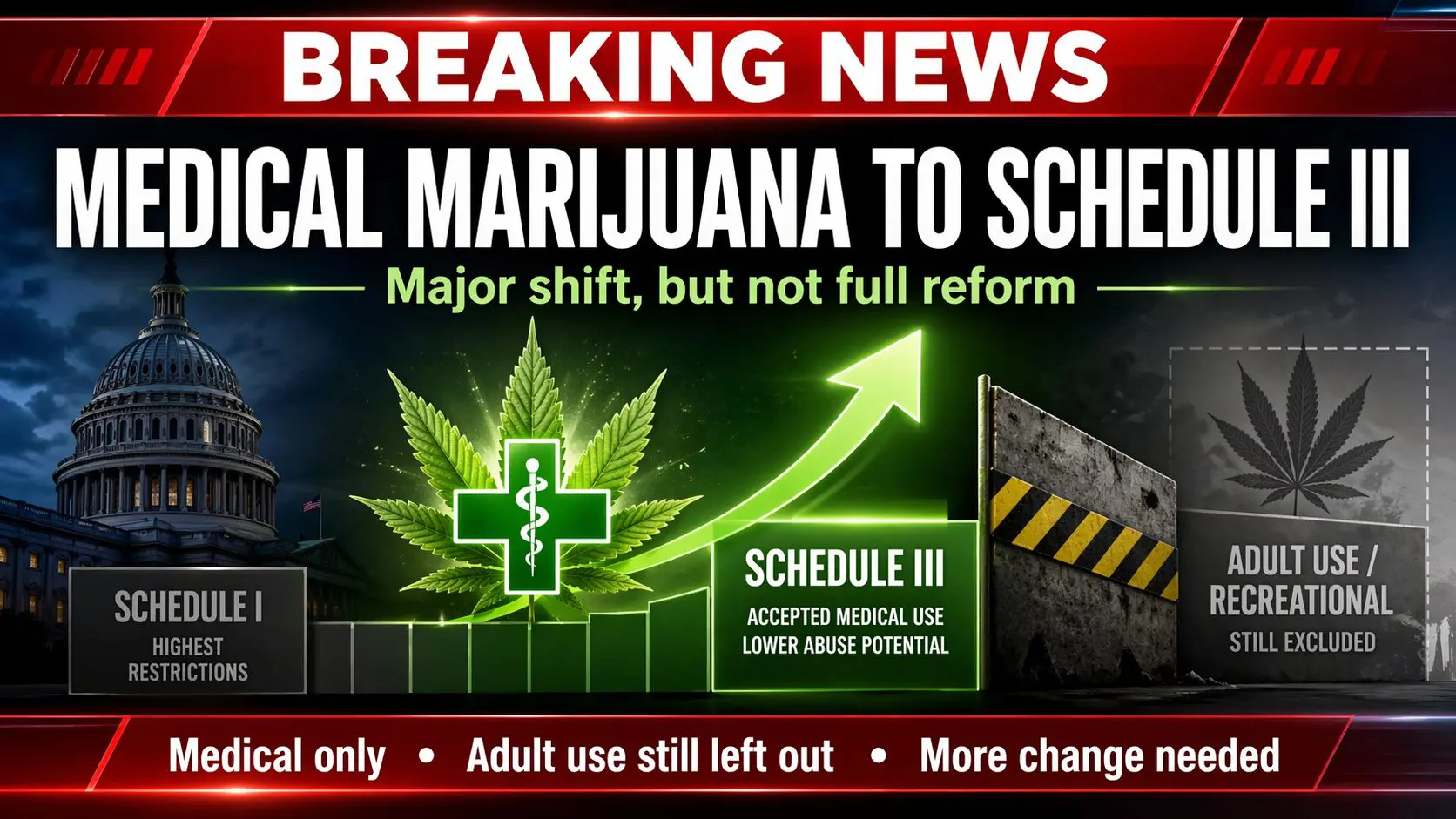
For years, cannabis advocates, industry operators, and policy watchers have dreamed of the day the federal government would move marijuana off Schedule I — off the shelf it shares with heroin, away from the company of substances deemed to have no accepted medical use and a high potential for abuse. Today, April 23, 2026, that day arrived. Acting Attorney General Todd Blanche signed the order. The DEA made it official. Cannabis, in limited form, is now a Schedule III controlled substance under federal law.
Savor the moment for a breath, and then read the fine print.
What moved to Schedule III is not cannabis as a category. It is not hemp-derived THC. It is not the THCA flower sitting in the case at your neighborhood smoke shop. It is not recreational marijuana, not CBD gummies, not delta-8 cartridges, not a single product in the vast and inventive gray market that has operated under the protective ambiguity of the 2018 Farm Bill. What moved to Schedule III is a carefully circumscribed set of products: FDA-approved drug formulations containing delta-9-THC derived from Cannabis sativa L., and marijuana subject to a qualifying state-issued medical marijuana license.
That’s it. That’s the win.
Everything else — and there is a great deal of everything else — remains Schedule I. Any marijuana product that is neither FDA-approved nor covered by a state medical license is still, under federal law, as illegal today as it was yesterday. The DOJ press release phrases this with lawyerly precision: the order applies to products “subject to a qualifying state-issued license authorizing the licensee to manufacture, distribute, and/or dispense marijuana or products containing marijuana for medical purposes.” The recreational market in legal states? Still Schedule I. The hemp-derived THC products that have carved out a multi-billion dollar niche in the regulatory gray zone? Still Schedule I. Still, potentially, federal felonies.
This distinction is not incidental. It is the architecture.
To understand why, you have to appreciate who benefits from today’s order and who does not. The clear winners are the multi-state operators — the MSOs that have spent years building licensed, regulated, vertically integrated cannabis businesses in states that permit medical use. These companies have labored under Section 280E of the Internal Revenue Code, a provision that denies standard business deductions to enterprises trafficking in Schedule I or II substances. Moving to Schedule III eliminates that burden, potentially freeing up tens of millions of dollars in annual tax liability for the larger operators. It also accelerates federally permitted research, clears a path for banking relationships long denied to Schedule I businesses, and, less tangibly but not insignificantly, removes some portion of the stigma that has clung to the industry like smoke to fabric.
The losers are the hemp-derived THC operators — the manufacturers, distributors, and retailers who have built businesses on the premise that Farm Bill hemp, with its permissive treatment of cannabinoids other than delta-9, created a lawful pathway to the intoxicating cannabis market. Today’s order does not validate their business model. If anything, it sharpens the line of demarcation between the licensed, legitimate cannabis industry and what the MSOs have long called the gray market — and have more recently started calling an unlawful competitor.
Consider the sequence. For the past two years, multi-state operators have been suing smoke shops and distributors across the country — in Missouri, Pennsylvania, and Texas among other states — arguing that hemp-derived THCA products are functionally marijuana and should never have been sold under Farm Bill cover. Today’s rescheduling order hands those operators a cleaner rhetorical weapon. If you want the protection of federal tolerance, get a state medical license. If you don’t have one, the federal government has just made its position more explicit, not less.
The order was signed by Todd Blanche, the acting attorney general, and it comes roughly four months after President Trump’s executive order directing the administration to move forward on rescheduling — a process that had languished through years of NPRM proceedings, administrative hearings, and public comment periods under the previous administration. That the Trump DOJ completed the move, however narrowly scoped, is genuinely notable. It is not the comprehensive reform that advocates sought, but it is a real policy change with real economic consequences for a real industry.
The next inflection point is June 29, 2026, when the DEA has announced it will convene an expedited hearing to consider whether marijuana as a category — not just the FDA-approved and state-licensed subset — should be reclassified to Schedule III as well. That hearing is where the broader argument will be fought. It is where the hemp industry will have to confront the question it has largely avoided: if marijuana moves to Schedule III wholesale, does the Farm Bill gray zone collapse entirely, or does it survive through a different legal theory?
No one has a clean answer to that question yet, which is precisely why it’s the most important question in cannabis policy right now.
What we know today is this: the federal government drew a line, and it drew that line around the licensed medical market. THCA is on the wrong side of it. Hemp-derived intoxicants are on the wrong side of it. The gray market — creative, entrepreneurial, constitutionally interesting, and genuinely beloved by the consumers it serves — just got a clearer target on its back.
That’s not a reason to despair. It’s a reason to pay very close attention to what happens on June 29.
Jay Maguire covers cannabis policy, hemp industry litigation, and the politics of drug reform. He is political editor of a cannabis industry trade publication and an investigator working on behalf of hemp retailers and distributors in regulatory and legal proceedings.
There is a particular kind of regulatory failure that does not arrive with subpoenas or headlines. It slips in quietly, dressed up in spreadsheets and procedural language, hiding in a denominator that nobody bothers to question. It looks clean, professional, even defensible—right up until someone actually runs the numbers.
That is precisely what has happened in the Texas Compassionate Use Program expansion under House Bill 46. The Department of Public Safety published a scoring rubric that promised a simple, balanced framework: four categories, each carrying equal weight. What the State implemented was not that framework. It was something materially different, and the difference is not philosophical or interpretive. It is mathematical, and it changed who won.
The Rule the State Published
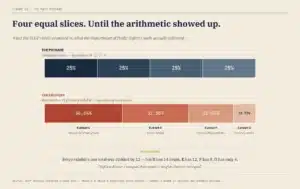
DPS told applicants, in plain English, that four categories would each account for 25 percent of the final score. Those categories—Security and Infrastructure, Accountability, Financial Responsibility, and Technical and Technological Ability—were presented as equal partners in the evaluation process.
There was nothing subtle about that promise. It was repeated in the rubric, relied upon in applicant preparation, and understood as the governing structure of the competition. Four equal slices of the pie, adding cleanly to one hundred percent. That is the rule applicants were told they were competing under.
The Structure Beneath the Rule
Beneath that clean promise, however, sat a more complicated reality. Each category contained a different number of scoring items. Security and Infrastructure included fourteen separate elements. Accountability included twelve. Financial Responsibility included eight. Technical and Technological Ability, the category that speaks most directly to whether an operator can actually run a compliant medical cannabis program, included just four.
Each of those items was scored by three evaluators on a scale of zero to five hundred. That structure produces dramatically different raw scoring ceilings. A perfect score in Security and Infrastructure reaches twenty-one thousand points, while a perfect score in Technical and Technological Ability tops out at six thousand.
There is nothing inherently improper about uneven category sizes. Any seasoned regulator or procurement officer has seen rubrics where some sections are more granular than others. The critical requirement, and the one that determines whether the system is fair, is normalization. If the State promises equal weighting, then each category must be scaled to ensure it actually contributes equally, regardless of how many individual items it contains.
What Equal Weighting Actually Requires
If you want four categories to count equally, the math is straightforward. You do not sum raw totals. You convert each category into a percentage of its own maximum possible score. Once each category is expressed as a percentage, you then apply equal weighting across those percentages.
In practical terms, that means taking an applicant’s score in each exhibit, dividing it by that exhibit’s maximum possible score, and then weighting each result at twenty-five percent. When you add those four weighted values together, you get a final score that reflects the rule the State said it would follow.
This is not exotic mathematics. It is standard practice across regulated industries, procurement systems, and competitive licensing frameworks. It is how you translate unequal components into equal influence.
What the State Actually Did
Instead of normalizing each category to its own maximum, DPS applied a single divisor across all four exhibits. Every raw score, regardless of whether it came from a category with fourteen items or one with four, was divided by twelve.
At first glance, that may look like a harmless simplification. It is not. When you divide unequal totals by the same number, you do not equalize them. You preserve their imbalance and carry it forward into the final score.
The result is a set of “Applicant Scores” that look standardized but are anything but. Security and Infrastructure retains a ceiling of 1,750 points, while Technical and Technological Ability is capped at just 500. When those numbers are combined, the weighting shifts dramatically. Security and Infrastructure ends up driving roughly thirty-seven percent of the final score. Accountability contributes about thirty-two percent. Financial Responsibility falls to roughly twenty-one percent. Technical and Technological Ability, the category that should stand shoulder to shoulder with the others, is reduced to just over ten percent.
That is not a rounding discrepancy or a clerical oversight. That is a complete reweighting of the system the State said it was using.
Why This Is Not a Close Call
There is no gray area here. Dividing unequal numbers by the same constant does not normalize them. It preserves their proportional differences. A category with a maximum score of twenty-one thousand will remain three and a half times more influential than a category capped at six thousand if both are subjected to the same divisor.
This is arithmetic, not interpretation. Once the method is set, the outcome follows automatically. The State did not accidentally drift away from equal weighting. It implemented a formula that could never produce equal weighting.
The result is that the rule applicants relied upon and the method used to evaluate them are not the same.
This Was Not an Isolated Mistake
If this were a one-off inconsistency buried in a single application, it might be dismissed as a transcription error. It is not. A review of virtually every scoring entry across both phases of the licensing process shows the same method applied without exception. Raw totals were divided by twelve, and those results were summed to produce final rankings.
This was the system. It was applied consistently. It was just not the system the State said it would use.
What Happens When You Fix the Math
When the applications are recalculated using the correct method—normalizing each category to its own maximum and then weighting them equally—the rankings change in ways that matter.
The very top of the list remains relatively stable. Companies that performed well across the board continue to perform well. The disruption occurs in the middle tier, where licenses are actually awarded.
Under the corrected calculation, three companies that received conditional licenses fall out of the top twelve. In their place, three different applicants move into winning position. Those new entrants are Texas-based operators who performed exceptionally well in Technical and Technological Ability, the very category that was most heavily discounted under the State’s method.
What emerges is not randomness or noise. It is a clear pattern. The flawed formula elevated categories with more scoring items—primarily infrastructure—and suppressed the influence of technical competence. When you restore the intended weighting, applicants who excelled in technical execution rise accordingly.
Why This Matters Beyond the Applicants
It is tempting to treat this as a dispute between competing companies, but that framing misses the point. Every license issued under this system determines where dispensaries are built, which companies invest capital in Texas, and how patients access medical cannabis.
For nearly a decade, Texas operated with just three dispensing organizations serving a vast and geographically dispersed patient population. House Bill 46 was supposed to correct that imbalance and bring the program into alignment with the needs of the state.
If the licensing process that governs that expansion is built on a misapplied formula, the consequences are not abstract. They are felt in the placement of facilities, the availability of products, and the ability of patients to obtain treatment without driving across half the state.
This is not a paperwork problem. It is a capacity allocation problem with real-world effects.
The State’s Position and Its Exposure
The State represented to applicants that each category would carry equal weight. Applicants relied on that representation in structuring their submissions. That reliance is not incidental; it is the foundation of the competitive process.
When the implemented methodology diverges from the published rule, the issue moves beyond process into legitimacy. The State is no longer simply defending a policy choice. It is defending a result that does not align with the rule it set.
That is a difficult position to maintain, particularly in a regulated industry where credibility is currency. Every future licensing decision, every enforcement action, and every legislative hearing will be measured against whether the State followed its own rules here.
The Path to Fixing It
The practical reality is that this problem is easier to fix than most regulatory failures. No one is asking the State to revisit subjective scoring decisions. The evaluators’ judgments on individual items are not in dispute, and the underlying data has already been recorded.
The correction is purely mathematical. Each exhibit score can be normalized to its maximum, weighted equally, and recombined into a final score that reflects the rule as written. From there, the State can determine how to align the licensing outcomes with the corrected rankings.
There are several paths available. They are known to DPS and the state leadership. The data is already in hand. The question is whether the State is willing to apply it correctly.
Final Consideration
This is not a partisan dispute or an ideological fight over cannabis policy. It is a question of whether a rule that was clearly stated was actually followed.
The State said each category would count equally. It used a formula that made them unequal. That is the entire issue, stripped of rhetoric.
Arithmetic has a way of cutting through arguments. It does not respond to intent or justification. It reflects only what was done. In this case, what was done does not match what was promised.
Texas now has a choice. It can defend the result as it stands, or it can correct the calculation and bring the outcome into alignment with the rule. The former invites challenge and erodes confidence. The latter restores both.
The calculator is indifferent. It will produce the same answer every time. The question is whether the State is prepared to accept it.
Author’s Note:
This article has been revised to more clearly present the scoring calculations underlying the Texas Compassionate Use Program licensing process. The updates expand the mathematical explanation and align the analysis with the methodology described in the State’s published rubric.
Rapper turns police raid into music… and wins on free speech Afroman just proved something loud and clear:
You can turn a police raid into a hit song — and win in court.
The rapper, best known for “Because I Got High,” came out victorious in a defamation lawsuit filed by seven Ohio sheriff’s deputies after he used footage of a 2022 raid on his home in a series of music videos.
FROM RAID TO RECORD
The whole situation started when law enforcement raided Afroman’s house on suspicions of drug activity and kidnapping.
They came in heavy…
Guns drawn
House searched
Property damaged
And found nothing.
No charges. No arrests. No case.
THEN HE DID WHAT ARTISTS DO
Instead of staying quiet, Afroman flipped the script.
He took home security footage of the raid and turned it into content — dropping viral music videos, including tracks off his “Lemon Pound Cake” project.
One clip even shows an officer distracted by a cake sitting on the counter — a moment that became internet gold.
THE LAWSUIT
The deputies didn’t find it funny.
They sued Afroman for defamation, claiming:
He damaged their reputations
They faced harassment after the videos dropped.
They deserved millions in damages
(Reportedly close to $4 million.)
THE VERDICT
The court didn’t buy it.
A jury sided with Afroman, ruling that his videos and music were protected under free speech, not defamation.
After the win, Afroman summed it up in true fashion:
“We did it… Freedom of speech.”
WHY THIS MATTERS
This case hits bigger than one rapper.
It’s about:
Free speech vs. law enforcement power
Art as protest
Who controls the narrative after a raid goes wrong.
Afroman didn’t just defend himself — he turned the system into content… and beat it at its own game.
Our BLAZED TAKE
Let’s be real…
They kicked in his door, found nothing, and then got mad when he made a song about it.
That’s not defamation —
that’s storytelling.
And now there’s a legal precedent backing it up. It was absolutely hilarious watching him on the stand last week absorbing everything the DA threw at Afroman, as he stood there in his USA flag suit and sun glasses, and he leaned right back into the prossicuter, throwing body shots, 1st Ammendment, then 4th Ammendment.
As a monthly practitioner of the 1st amendment we are most proud of you Afroman and would love to get you on the podcast.
WARNING: THE REPORT DAN PATRICK DOESN’T WANT YOU TO SEE!
In Texas, we’ve seen this before: a political agenda dressed up as public safety, a compliant bureaucracy, and the weaponization of bad science to justify bad law. But this time, it’s not marijuana. It’s legal hemp—and the state’s own forensic watchdog warned them not to do it.
The Science Was Clear
In July 2021, the Texas Forensic Science Commission (FSC) issued a report questioning the reliability of gas chromatography (GC) testing methods—specifically the kind used by Armstrong Forensic Laboratory—in determining THC levels in cannabis samples. The problem? GC destroys the chemical integrity of the sample by heating it, converting non-psychoactive THCa into delta-9 THC. The result: legal hemp often appears “hot” when tested this way.
By April 2025, the Commission had grown more urgent. In a formal warning, it told prosecutors and law enforcement not to rely on GC-MS without derivatization—the exact method Armstrong was using—because it does not distinguish between THCa and delta-9 THC in processed products like vape pens and edibles. The Commission’s position was clear: GC is not scientifically valid for the enforcement of Texas hemp laws. The right tool? High-performance liquid chromatography (HPLC), which preserves the cannabinoid profile without artificially inflating THC levels.
DPS Didn’t Just Ignore the Science—They Sought Out Bad Results
Despite having access to state-run, accredited labs that used validated HPLC methods, the Texas Department of Public Safety (DPS) chose Armstrong Labs. Why? Because Armstrong’s flawed GC testing produced the kind of “hot” results that could turn lawful retail inventory into felony contraband on paper.
This wasn’t just negligence—it was selective science-shopping. DPS bypassed better labs and used the one that would give them the numbers needed to justify search and arrest warrants. Those warrants led to a coordinated series of raids in August 2024 across North Texas, most prominently in Allen, where nine hemp retailers—nearly all minority-owned—were raided. Doors were kicked in. Products were seized. People were arrested. Lives were disrupted.
And when asked about the scientific controversy, DEA Special Agent Eduardo A. Chávez, standing behind a row of local police chiefs, said the quiet part out loud:
“We’re not going to get into a scientific debate.”
That’s because there was no debate. The science was already settled—just not in their favor.
Dan Patrick’s Fingerprints
The timing and utility of these raids are no coincidence. Lt. Governor Dan Patrick, a long-time prohibitionist, has made clear his desire to eliminate the hemp-derived THC market. Along with Senator Charles Perry, he introduced Senate Bill 3, a sweeping measure to criminalize and regulate hemp in ways that would effectively shut down thousands of small businesses statewide.
But Patrick’s proposals needed fuel—a sense of public danger. That’s where the Allen raids came in. News coverage of the raids, complete with sensational claims about high-THC products and cash seizures, created the illusion of widespread criminality. Those raids—and the test results behind them—became Exhibit A in the Senate’s push for SB 3.
In reality, the entire operation was built on sand. The lab method was known to be invalid. The warrants were based on forensically unsound evidence. The prosecutions have largely stalled or gone unfiled. But the political damage was done—and the policy momentum created by those raids is still being used to push bans, criminal penalties, and massive regulatory overreach.
The Consequences
Dozens of stores have closed. Millions in assets have been seized. Texas entrepreneurs—many from immigrant and minority communities—have been branded criminals for selling federally legal hemp products. Some of the retailers caught in this net can’t even afford legal counsel; their bank accounts are frozen, their reputations destroyed.
All because DPS chose the wrong lab on purpose.
If It’s Not Illegal, It’s Worse
Some may argue no laws were broken. But that’s the problem. When law enforcement uses scientifically invalid methods, even after being formally warned twice by the state’s own scientific authority, it isn’t just a technical error. It’s an abuse of power. Under Texas Penal Code §39.03, this pattern begins to resemble official oppression—public servants using their authority to target people unjustly under the color of law.
And the Fourth Amendment may also come into play. Raids based on scientifically discredited probable cause are ripe for constitutional challenge. The state didn’t just bend the law—it bent science, and it bent justice.
The Big Lie, Texas Edition
Dan Patrick’s prohibitionist crusade depends on the belief that hemp stores are fronts for drug dealers. But the science doesn’t support that claim, and neither do the facts. What we’re seeing is the deliberate manufacture of criminality using rigged lab results and coordinated enforcement—all to push a bill that benefits entrenched political allies and clears the market for the few operators who can afford to comply.
This is Reefer Madness 2.0—driven by bad labs, bad busts, and big lies.
(Austin, TX) Todd Harris, co-owner of Austin, Texas-based The Happy Cactus Apothecary, testified in opposition to the anti-hemp bill Texas SB3. Harris spoke out against the bill during hearings conducted by the State Affairs Committee of the Texas House of Representatives on April 7, 2025.
Harris introduced his family-owned and legal hemp business to the committee. He explained in his testimony that:
All customers must prove they are 21+, even if they are the Lieutenant Governor of Texas.
Happy Cactus has passed each of four inspections by the Texas Department of Health Services during the past 18 months.
The legal hemp industry in Texas is a much more effective program for Texans than the Texas Compassionate Use Program. (TCUP)
Packaging is marketed to adults, not children. Look-alike products are not allowed.
QR codes are available for customers to view test results and analysis.
The local high school was informed by three letters that students are not allowed in the Happy Cactus.
Good morning. Thank you all so much for volunteering your time to be here and listen to us. That’s an amazing thing, and we appreciate that. I do want to discuss a few points on why I am against SB3 and the three issues that I see with our current situation in Texas; I think we have at our shop (have a) slightly interesting perspective for three reasons. We have been inspected by DSHS (Texas Department of Health Services) four times in the last year and a half. The Lieutenant Governor Dan Patrick has visited our shop as well as we are across from a high school. If you have any questions about those, happy to answer; like I said, our shop has been inspected by DSHS four times in the last one and a half years, and we have passed with flying colors every time. I told the Lieutenant Governor this when he came into our shop, and he even said, it sounds like you guys are doing it right; we carded Dan Patrick.
We showed him we have our testing in (our) shop or via QR codes on each product we sell. We showed him we do not have packaging tailored towards children and showed him we don’t have any products over 25 milligrams per serving. So we were able to squash all the issues he has with the hemp industry all in one visit from just one of the amazing family-owned hemp business businesses here in Texas; Dan Patrick told me that he supports shops like ours that are doing it right. Feels very different from his attitude about it in the media.
One of the reasons we have been inspected so often is because TCUP (Texas Compassionate Use Program) did a piece with Texas Monthly last summer. This article called out eight shops in Texas, including ours, saying they tested our products and that we are selling illegal products. DSHS came to our shop the following week; we passed the inspection easily again. So why is TCUP trying to mess with businesses like ours? Probably because they know the hemp industry is a much more effective program for Texans than the Compassionate Use Program.
Additionally, the inspector, Mr. Chambers, told us that there are only eight inspectors in the entire state of Texas. How are eight people supposed to enforce the regulations already set in place, and why, especially with 8,000 shops, and he said he only goes to one shop or two, maybe a week. And why are they visiting our shop so often when we have shown we are in compliance?
State Representative John McQueeney asks a question
You said that your products had no more than 25 milligrams per serving indeed. How does that correlate to this .03 that we that is in the regulations?
Todd Harris
The 0.3%?
State Representative John McQueeney
Yes.
Todd Harris
The 0.3% is per dry weight. So, with an edible, you just have to make sure the edible is heavy enough or big enough that you can fit 25 milligrams in there and still be under 0.3% per dry weight. It’s actually very easy to do. They’re actually are very close to that already in Colorado, and California. We use Vegan gummies that are a little heavier.
State Representative John McQueeney
Is that an intoxicating dose, or is that I’ve got PTSD, and it’s gonna make me calm down?
Todd Harris
So I think intoxicating is objective.
State Representative John McQueeney
Is it comparable to having a couple beers?
Todd Harris
Me and my wife take around 50 milligrams every time and or when we need to just have relief. For some people, 25 milligrams can just be relief. And for some people, it’s, you know, they can’t even feel it.
State Representative John McQueeney
There are some people that would get a euphoric feeling from that dosage, and some people that would not. Is what you’re saying?
Todd Harris
I agree.
State Representative John McQueeney
Yeah. Thank you
Todd Harris
Thank you, Mr. Chairman, and I want to mention, so I passed out a letter that we actually sent to the high school that we’re across from, letting them know that it’s trespassing for their students to enter our shop as well. And we sent that six months ago. We sent them three letters, and we actually have a meeting with the principal now, and that is something we’ve done before he even mentioned SB3. It’s something we’ve been doing for four years, keeping carding everyone in our shop.
For media interviews with Todd and Mickey Harris, Happy Cactus Owners, please contact Kevin Lampe at (312) 617-7280 or kevin@kurthlampe.com.
In just days, the Texas hemp industry faces what may be its defining moment since legalization in 2019. The House State Affairs Committee, chaired by Representative Ken King, will convene Monday morning to hear testimony on two bills with starkly different visions for the future of hemp in Texas.
The hearing, scheduled for 8:00 AM on April 7 in room JHR 120, will feature two competing approaches to hemp regulation that could not be more different in their impact on the thousands of businesses and workers in this growing sector.
A Tale of Two Bills
House Bill 28, authored by Chairman King himself, represents a regulatory path forward. While imposing new restrictions—including age verification requirements, licensing standards, and quality controls—it allows the industry to continue operating under enhanced oversight. This approach acknowledges the economic reality that the hemp industry has become a significant contributor to the Texas economy.
In stark contrast stands Senate Bill 3, championed by Senator Perry and already passed by the Senate with Lieutenant Governor Patrick’s backing. This bill takes a prohibitionist stance, effectively banning most hemp-derived products beyond CBD and CBG. The practical effect would be the criminalization of businesses that have been operating legally since hemp was federalized and then legalized in Texas.
The Texas hemp industry must recognize this hearing as a truly existential moment. The difference between these bills is the difference between a future for hemp in Texas and no future at all.
The Stakes for Texas Businesses
For hemp entrepreneurs across Texas who have invested everything in building compliant businesses, Monday’s hearing represents a crossroads. Many have implemented strict age verification, comprehensive product testing, and responsible marketing practices that avoid targeting young people. Despite these efforts, SB 3 would shut down operations overnight, resulting in job losses throughout the supply chain.
These business owners aren’t alone. Thousands of Texans now work in hemp-related businesses across the state, from cultivation to manufacturing to retail. Many industry stakeholders emphasize they’re not opposed to reasonable regulation.
The hemp industry broadly acknowledges the need for age restrictions, quality control standards, and responsible business practices. The objection is to prohibition disguised as regulation—the difference between workable rules and an outright ban that destroys livelihoods.
Two Minutes to Make a Difference
Those planning to attend Monday’s hearing should note that public testimony will be limited to just two minutes per person—barely enough time to introduce oneself and make a few key points. This limitation makes preparation essential.
Industry advocates recommend business owners focus their brief testimony on concrete facts: business location, number of employees, economic impact, and specific measures implemented to prevent youth access. Those unable to attend in person can submit written comments electronically through the House website until the hearing concludes.
Experienced observers of the legislative process note that lawmakers respond best to personal stories with specific details. Effective testimony should explain exactly how SB 3 would affect individual businesses, employees, and communities while emphasizing support for appropriate regulation rather than prohibition.
Regulation vs. Prohibition
The fundamental question before the committee is whether Texas will embrace a regulated hemp market or attempt to put the genie back in the bottle through prohibition.
Historical evidence suggests prohibition rarely works as intended. Rather than eliminating products, prohibition typically drives markets underground, removing quality controls and age verification while enriching illicit operators. Meanwhile, legitimate businesses close, tax revenue disappears, and products simply flow in from neighboring states with more permissive laws, not to mention empowering drug cartels by creating a supply vacuum.
Economic analysts point out that prohibition doesn’t eliminate demand—it just changes who profits from it and removes safeguards for consumers.
The Time for Action
As Monday approaches, the Texas hemp industry faces its most significant challenge yet. The businesses that have operated transparently and responsibly since 2019 must now make their case directly to lawmakers that regulation, not prohibition, is the path forward.
Whether through in-person testimony, written comments, or direct outreach to committee members, every voice matters in this crucial debate about the future of hemp in Texas. For thousands of business owners and their employees, Monday’s hearing may well determine whether they have a future in this industry at all.
Committee Hearing Information
Time: 8:00 AM, Monday, April 7, 2025 Location: JHR 120, Texas Capitol Committee: House State Affairs Chair: Rep. Ken King
Monday morning at 8am the Texas House State Affairs Committee will begin, and will include SB3 on their agenda for the day along with HB 28.
This does not mean that the committee will hear the bill the first thing in the morning. It is possible that other bills may be added and heard first with minimal testimony, just to get them out of the way.
At the time of writing though only the two hemp bills sit on the agenda for the committee that day. It could be expected that many people show up and something similar to what Texans saw in the Senate committee hearing could take place with it being an all day hearing of testimony.
THIS IS THE LAST CHANCE FOR TEXANS TO VOICE ON THE RECORD WHAT THEIR CONCERNS ARE WITH SB3
If you are a shop owner and your livelihood is on the line because of this bill, this hearing should be priority for you. This is the last time and only time in the House that your testimony can go on the official record and everyone gets a chance to testify.
The hearing will take place in the Reagan building in room JHR20. That’s on the 2nd floor of the Reagan Building which can be located on the map above circled in red. You must register at the capitol the day of the hearing to testify. Testimony will be limited to 2 min and the House hearing are usually strict on the 2 min time limit unlike the Senate which gives some leniency.
To submit written testimony to the Texas House, prepare a concise document (ideally under 3-5 minutes worth of reading try to stay within 1 to 2 pages max) and submit it to the committee clerk, along with 20 copies for the committee members, before or during the hearing.
TIPS ON CRAFTING and GIVING TESTIMONY
Stories that are common are not bad, but get repetitive and implicitly unwanted as they become memorable in a more negative light than positive. Give your original perspective, listen to other testify and mold your own verbal testimony to what others have noted as to not overlap so much. It is not advised that one speak on medical topics as though they are medical experts unless they are a medical expert, the Senate is using this against the industry in that it proposed they should be in the medical program (despite its gross limitations).
To go over this again, this is meaning don’t talk like a medical expert or the medical relief it gives you or your clients. Therapeutics is one thing, but discussing THCa like its the fuel for healing everything is not a good move.
If you have any questions, feel free to message us through our contact page, social media accounts Facebook and Instagram, or even on LinkedIn. We want to be organized and professional.
And last but not least, dress business casual or business professional. A good rule of thumb is dress LIKE YOU ARE GOING TO COURT AND GOING TO BE IN FRONT A JUDGE. The Capitol is an official court house and the attire of such meetings is expected to be approximate as such. Dressing as though you are going to a grunge concert in the middle of Iowa give an impression of a lack of concern or care for your attendance and the gravity of the matter at hand.
Just relax and be calm
It is an emotional hell ride at times and the mileage of what you feel may vary. That’s okay. Anger and Sadness are not uncommon, but it is not justification to go into a physical tantrum. It can get you removed from the building and it doesn’t look good. And do not use foul language, it isn’t classy to sound like a salty sailor pulling into Baltimore.
Texas, lets go defend our market and get the right moves made to make our market even better with proper regulations.
Story originally appeared on our with colleagues website at Texas Cannabis Collective:
CRAFT Leads the Way in Hemp Compliance as SB 3 Threatens Industry
As the Texas Legislature debates SB 3—a bill that would ban all THC products—responsible hemp retailers across the state are stepping up to protect their businesses, their customers, and their communities.
For the past 18 months, Texas hemp industry advocates, business owners, policy and legal experts have worked to create a set of training modules, model store manuals, SOPs and other compliance-related business standards that can be adopted statewide to assist small businesses with building their compliance and sales capacity while pushing back against the false narratives being used to push the Prohibitionist ban agenda. The Cannabis Retailers Alliance for Texas (CRAFT) is a multi-sector industry-led effort to prove that the hemp industry is capable of self-regulation. Our members have voluntarily implemented a 21+ age policy, adopted rigorous product sourcing and testing standards, and developed a comprehensive Retailer Playbook to help businesses stay compliant in a shifting legal environment.
Our members didn’t wait for politicians to tell them what’s right,” said Jay Maguire, CRAFT co-founder and spokesperson. “Moral panics don’t start with facts—they start with fear. And that’s exactly what Lt. Governor Dan Patrick and Senator Charles Perry relied on: Reefer Madness-style scare tactics and cherry-picked anecdotes. Even when the stories were true, they were outliers—not the norm. The vast majority of retailers are doing the right thing. CRAFT members voluntarily enforce a 21+ age policy and card every customer at the point of sale—just like alcohol and tobacco. That’s what responsible businesses do.”
When Lt. Governor Dan Patrick visited Happy Cactus shop in Austin last week unannounced and looking for evidence of super-high THC products, he was expecting a political “gotcha” moment. What he found instead was a professional, compliant business, stocked with compliant products and operated with trained staff following company policy, carding customers and following best practices. That’s not politics—that’s policy in action.
Key leaders in the hemp space are weighing in:
• Rhiannon Yard, owner of Hemp Gaia, says: “We teach retailers how to verify COAs match the products on their shelves and ensure lab tests were done using the correct methods at accredited labs. That’s how we protect our customers and our licenses.”
• Nick Mortillaro, owner of Lazydaze Coffeeshops, adds: “Retailers need to cut through the buzz and noise with real, evidence-based education. That’s what CRAFT provides.”
• Brian Dombrowsky, owner of Aim High Distro, says: “CRAFT helps business owners stay licensed and build trust by educating their communities about what they do.”
The public already supports this approach. Polls show that 68% of Texans favor safe, regulated access to THC—and the $8 billion Texas hemp market proves they’re voting with their wallets.
📣 To read the full press release or to join the movement, visit joincraft.org
If you’d like to learn more, speak with a CRAFT spokesperson, or schedule a visit to one of our member retailers, feel free to reach out directly.
Texas Lt. Governor Dan Patrick Visits Responsibly-Managed Austin-Based Legal-Hemp Retailer
Yesterday, Texas Lieutenant Governor Dan Patrick visited the Happy Cactus, a legal hemp retailer in Austin, Texas. When Patrick entered the store, the employees asked for identification to verify his age. He complied and showed his ID, proving he was over 21.
The Happy Cactus team followed the standards of best practices established by the Cannabis Retailers Alliance for Texas and other organizations. Patrick asked about gummies and if products with more than 50mg per serving of hemp were available. Co-owner Todd Harris informed him products with more than 50mg per serving are NOT available in the store.
Patrick claimed that students from Crockett High School had been in the store. Harris said everyone who enters the store is asked for identification to prove they are over 21. Harris’ attorney sent Crockett High School administrators a letter warning students not to trespass in the store. The letter was sent more than six months ago.
“We are proud of our team here at Happy Cactus. They handled the visit according to the best practices of Texas hemp retailers and with professionalism and respect,” said Harris. “We are proud to provide a legal product that helps many people in our community, including veterans and seniors.”
“We are grateful that Lieutenant Governor Patrick decided to investigate stores on his own. We are very pleased that he chose Happy Cactus because they are one of the best examples of how to run a store properly. It’s obvious that they carry quality products for people in need and take extreme precautions to ensure their products do not fall into the wrong hands. They even ‘carded” Lieutenant Governor Patrick without knowing who he was,” stated David Sergi of Sergi & Associates.
“Lieutenant Governor Patrick came into Happy Cactus, our Client’s store, and saw that we do things correctly. He learned that we had sent a no-trespass letter to Crockett High School because we didn’t want their students in our store. He also learned that their students no longer attempt to come into our store. Happy Cactus does things right like most of our industry,” said David Sergi.
A video of the visit is here: https://www.dropbox.com/t/CvXgh9fbTRXidBSJ
For media interviews with Todd and Mickey Harris, Happy Cactus Owners, or David Sergi, Attorney for Happy Cactus, please contact Kevin Lampe at (312) 617-7280 or kevin@kurthlampe.com.
In an effort to remain vigilant and true to his word Texas Lt. Governor Dan Patrick is now making house calls to area store owners in a measure of enforcement that goes right to the top!
Employees of south Austin store owner Todd Harris of the Happy Cactus were greeted with questions about products his stores sell and legal dosing and compliance concerns as any grandmother might before making a legal purchase of CBD cream, or maybe a Texas Veteran who was looking for a gummy for a better night’s sleep.
Only this “house-call” was made by none other than Mr. SB 3 himself, Texas Lieutenant Governor Dan Patrick.
Happy Cactus, like many industry retailers are following a set of best compliance practices which are part of a statewide effort led by organizations such as (CRAFT) Cannabis Retailers Alliance for Texas.
According to Harris, Dan Patrick came in and asked about gummies and how many milligrams he had on certain legal-hemp products. Staff members provided info on one such item that was 50mg to the Lt. Governor as more questions ensued. Harris explained that products over 50mg are not available at his stores.
The Texas lawmaker also entered a line of questioning to Harris that alleged that students from nearby Crockett High School had come into the Happy Cactus when Happy Cactus staff insured Patrick that they not only card everyone that attends its establishment, but under his attorney’s advice they have sent the school a trespass warning so students know not to visit. That notice was delivered over six months ago.
“Lieutenant governor Patrick came into our Client store and found out that we do things the right way. He was even carded. He learned that we had sent a no trespass letter to Crockett high school because we don’t want their students in our store and he also learned that their students no longer attempt to come into our store and that we do things right like most of the rest of our industry. ” – Stated David Sergi the attorney of record for the south Austin retailer.
Security Video of Happy Cactus shows Patrick and his staffers coming into the south Austin store for an official visit. Unresponsive to Happy Cactus employees request for ID the Lt. Governor of Texas went on to explain that he was “Dan Patrick”. The Employee still demanded the identification. Afterwards, Todd Harris was notified by staff of the cordial visit by the top Texas lawmaker.
Harris and Sergi both emphasized that “we are grateful that Lieutenant governor Patrick decided to investigate stores on his own and very pleased that he chose Happy Cactus because they are one of the best examples of how to do how to run a store properly. It’s obvious that they carry quality products for people in need and take extreme precautions to ensure their products dont fall into the wrong hands. They even carded lieutenant governor Patrick without knowing who he was.” stated David Sergi of Sergi & Associates.
Details of the Call can be heard here, and the security tape recorded the visit.
The Happy Cactus is located at 5700 Menchaca Rd Ste # 520 and is owned by brothers Mickey & Todd Harris from Austin TX.
The Texas Legislature is not kind to perceived bad industries that show division. Lawmakers, especially those in the governing party, are well-practiced in divide-and-rule. When they see infighting, they exploit it. When they see an industry that can’t even align on its own interests, they stop taking it seriously. That is why survival in this fight depends entirely on solidarity.
And yet, Bayou City Hemp just made the worst possible mistake. By circulating a flyer in the Capitol calling for a ban on all smokable hemp—without even informing their own trade association leaders—they didn’t just undermine the industry’s collective voice. They handed prohibitionists exactly what they wanted: proof that even we aren’t convinced of our own legitimacy.
It’s as if, seeing the torpedo in the water, Bayou City launched their own life raft, hoping to save themselves before the ship went down. But that’s not how this works. The prohibitionists don’t see them as allies—they see them as easy targets. The second the industry collapses, Bayou City’s raft won’t be spared. It will be machine-gunned like the rest. And in the process, they’ve weakened the entire industry’s argument for reasonable regulation. Instead of presenting a united front to lawmakers, they’ve reinforced the very narrative prohibitionists are pushing—that this is an industry that cannot regulate itself and therefore must be banned altogether.
If they truly believed in this course of action, they should have done it the right way—resigning from the board, stating their case within industry discussion groups and working with the professional advocates and advocacy groups—who are expert at understanding the political landscape, the unwritten rules, and finding ways to win when weaker sisters panic—to find a compromises and creative solutions. For example, the main knock on our industry right now is the largely unproven allegation that we sell and market to kids. While we can all agree that mimicking brands of children cereals and candies is a bad look, there’s no Joe Camel-level duplicity happening here but the narrative is established and refuting it costs more energy than we any benefit we’d derive from engaging in the “I know you are, but what am I?” tropes that so often ensue in similar circumstances.
The answer: we’ve been working diligently to identify and refine technologies that make it much less chancy when it comes to age gating—as an upcoming article in Special Legislative issue of the Texas Hemp Reporter will demonstrate, harnessing the power of AI and facial recognition tightens up on the one area of weakness we all admit we have—consistent carding of customers and retail clerks who are 100% compliant and on the ball every single transaction.
As you’ll see from the machines, we can show law makers we’ve got it figured out and seek collaboration on areas of alignment, not mindless deflection to other players in industry when we feel out own interests threatened. This is just one example of what Bayou City might have done. Instead, they’ve set the stage for a circular firing squad within the industry, betraying the broader interests they had at least an arguable duty to represent and doing the prohibitionists’ work of undermining credibility for them.
Now is the time for discipline, not desperation. If we want lawmakers to treat this as a mature, responsible industry worthy of negotiation, we need to act like one. Anything less, and we are simply making the case for our own demise.
Political Commentary | Jay Maguire – Political Editor Texas Hemp Reporter –
Senate Bill 3, introduced by Senator Charles Perry and backed by Lieutenant Governor Dan Patrick, represents Texas’ most aggressive crackdown on hemp-derived cannabinoids. The bill would ban all cannabinoids except CBD and CBG, effectively outlawing products containing delta-8 and delta-9 THC, which have flourished due to legal gray areas. Supporters argue that these products pose safety risks, particularly to minors, while opponents see the bill as an unnecessary expansion of government control that would cripple Texas’ legal hemp industry.
But this legislation isn’t just about hemp—it’s part of a broader far-right agenda in Texas, where Patrick and Perry have used their power to push extreme culture war policies. Patrick, in particular, has been instrumental in Texas’ hard-right turn, attacking public education, LGBTQ+ rights, and any form of marijuana legalization under the guise of protecting “traditional values.” This latest push to ban hemp-derived cannabinoids aligns with their long-standing efforts to extend the failed War on Drugs, despite mounting evidence that criminalization doesn’t work.
The financial backing behind this movement is critical to understanding what’s happening. Patrick’s biggest donor, West Texas oil billionaire Tim Dunn, has poured millions into reshaping Texas politics, funding primary challenges against Republicans who aren’t conservative enough. Dunn’s money has fueled attacks on public education, voting rights, and any policy that doesn’t fit his ultra-conservative, Christian nationalist vision for the state. In that context, SB3 isn’t just about hemp—it’s about control. It’s another example of Texas’ political machine prioritizing ideological battles over economic freedom, despite the fact that the hemp industry has created jobs and generated revenue for the state.
If SB3 passes, it will take effect on September 1, 2025, with retailers required to comply by January 1, 2026. But for Patrick and Perry, the bill’s impact goes beyond just shutting down hemp businesses—it’s part of a larger strategy to shape Texas in their far-right image, using the War on Drugs as a tool to maintain power.
On a quiet morning in a town that could be anywhere—though, in truth, it sits under a
blazing Texan sun—two figures stand at a crossroads. One is an old farmer, face lined
with decades of toiling in the fields, familiar with the gentle hum of wind through
cannabis leaves. He smiles easily, remembering a time when all he had was the plant,
its naturally occurring Delta-9 THC dancing beneath the sun, a secret he could trust.
The other figure, a young chemist in a crisp white lab coat, fresh from a makeshift
laboratory hidden behind a steel door, cradles a vial of something new, something
strange: a synthesized cannabinoid conjured not by nature, but by human ingenuity.
They meet by a rickety wooden sign that reads: “HEMP—0.3% THC LIMIT.” It’s a relic
from a not-so-distant past, a guideline that changed the course of everything. On one
side of the sign, fields of hemp sway under legally sanctioned skies, their Delta-9 THC
content tightly bound by regulation. On the other side, a world of possibility and
confusion blooms—hemp-derived molecules twisted, converted, and reshaped into
something both eerily familiar and unstintingly new: Delta-8, THCP, HHC, and more.
The farmer remembers a hypothetical: If you could hop into a time machine—say, back
to 2018—and whisper in the ear of a president, “Legalize cannabis outright,” would all of
this tinkering have been necessary? Would there be a room full of chemists bending
molecules to comply with laws rather than to discover truth? One timeline might have
yielded an abundance of natural Delta-9 THC, openly grown, studied, and enjoyed
without the shadowy dance around percentages. But in the timeline we have, clever
minds spotted a legal loophole and seized it. Thus, a new era was born.
The chemist, for their part, isn’t some cartoon villain. They are a seeker of knowledge.
They might say, “Nature is wondrous, but so is the human mind. If we can create a
molecule that offers therapeutic benefits that Delta-9 can’t, why not do it?” Yet the
farmer counters, “If we’d just started by legalizing the original plant, would we have even
bothered? Isn’t Mother Nature’s original blueprint enough?”
People come from all corners to argue. Some say these synthetic cannabinoids have
opened doors: they’ve allowed consumers in places like Texas to experience something
close to the Delta-9 high without openly defying the law. They’ve ushered in a future
where new pharmaceuticals and nutraceuticals might arise—substances that could help
ailments where old solutions fell short. Others warn of unknown dangers. Unregulated
synthetics have sent people reeling into hospital beds, their minds spinning into worlds
they never wanted to see. Safety data is thin, and no one’s quite sure what happens
when these new molecules dance in human biology over the long term.
In the distance, smoke rises from another battlefield. Texas lawmakers threaten to end
all THC sales—Delta-9, Delta-8, and everything in between—citing confusion, public
safety, and unforeseen consequences of the hemp loophole. Thousands of shop
owners face ruin. Consumers who rely on these cannabinoids for relief may lose their
access entirely. This ban wouldn’t just target the chemists and the labs; it would also
strike at the humble farmers and their fields of green. One might ask: Whose fault is this
tightening noose? The natural Delta-9 that sparked fear long ago, or the synthetic
creations that emerged only because Delta-9 was kept at arm’s length?
And what of medicine? The Texas Compassionate Use Program (TCUP) only permits
naturally occurring cannabinoids. There’s a sanctity, it seems, in what the plant chooses
to provide. Yet, shouldn’t we at least ask if the new synthetics deserve study and
scrutiny in clinical environments? Could they be tamed, understood, and perhaps one
day trusted? Or should they remain at the edges, a wild frontier too dangerous to bring
into the doctor’s office?
These questions swirl like smoke in the twilight air. The farmer and the chemist watch
the horizon. They know lawmakers, lobbyists, patients, and business owners are all
involved—everyone is shouting, everyone is pushing, everyone is pulling. It’s a war of
definitions: What is natural? What is safe? What should be allowed? And beneath these
questions lies an even deeper one: Who are we to decide what belongs in our bodies,
and at what cost?
By now, we are all standing at that crossroads, squinting into a future fogged by
uncertainty. Does the “natural” inherently mean safer, better, more ethical? Or does
human innovation hold a torch that illuminates pathways nature never considered? If
time were reversed, would we just legalize Delta-9 THC and spare ourselves this maze
of molecular modifications? Or would we still crave something new, different, and
perhaps better?
scientist experimenting with cannabis in the lab made with AI
In the end, the figures fade, and we are left with the riddle itself. Just as Hamlet once
pondered “To be or not to be,” we are left wondering: to inhale the old ways or embrace
the new; to trust nature’s leaf or trust the alchemy of the lab; to ban them all or find a
delicate balance.
We stand, each of us, at that same dusty crossroads, knowing there is no easy answer.
In our hesitation, we discover that we are not truly debating chemistry or law. We are
asking who we are as a society—our values, our hopes, our fears. And perhaps, in that
silent pause, we will learn something about existence itself.