The Texas Hemp Constitutional Alliance amended lawsuit challenges several new hemp rules adopted by the Texas Department of State Health Services (DSHS).
This lawsuit is not primarily about hemp.
According to the lawsuit, it is about whether a state agency can change laws that were written by the Texas Legislature.
In 2019, the Texas Legislature passed House Bill 1325, creating the legal framework for consumable hemp products in Texas.
According to the lawsuit, that law already addressed THCA.
For example, lawmakers required licensed hemp growers to account for THCA during pre-harvest testing.
However, when lawmakers wrote the rules for manufacturers and finished hemp products, they used different language.
Instead of requiring the same testing method, the Legislature created three different ways manufacturers could legally demonstrate compliance:
• Pre-Manufacturing Testing
• Pre-Retail Testing
• Constituent Compliance
According to the lawsuit, none of these three compliance methods require the new “total delta-9 THC” testing standard created by DSHS.
Instead, the lawsuit argues that DSHS adopted an entirely new testing standard.
According to the lawsuit, that rule doesn’t simply add another testing requirement.
It materially changes one of the Legislature’s compliance methods, completely eliminates two others, and requires new testing at stages where the statutes themselves do not require testing.
THCA joins the Blazed Weekly News Podcast this week. September 10th.
The lawsuit argues that if the Legislature wanted manufacturers to use the same testing method required of growers, it knew exactly how to say so—because it already did in another section of Texas law.
Instead, lawmakers chose different language when writing the rules for manufacturers.
According to the lawsuit, those differences were intentional and must be given meaning.
A regulator cannot void a statute it is charged with implementing.
The lawsuit argues that DSHS exceeded its authority by replacing compliance methods created by the Texas Legislature with new requirements created through agency rulemaking.
In addition to the testing requirements, the lawsuit also challenges:
• Dramatic increases in manufacturer and retailer licensing fees, arguing they exceed DSHS’s authority and amount to an unconstitutional tax.
• New packaging and labeling requirements that the lawsuit argues conflict with the statutes passed by the Texas Legislature.
If the Texas Legislature wants to change Texas law, it has every constitutional right to do so.
The lawsuit asks a different question:
Can DSHS make those changes on its own through rulemaking, or must those changes come from the Texas Legislature? In our opinion, it CANNOT!
Federal hemp update — September 4: There is a meaningful new development in the post-delay negotiations.
Texas Rep. Beth Van Duyne says the White House is taking the hemp issue seriously now that the December 11 extension is law. She is pushing her proposal to keep hemp-derived THC beverages federally legal under an alcohol-style framework, with age restrictions, taxation, serving limits, marketing controls and a prohibition on synthetic cannabinoids.
At the same time, Rep. Morgan Griffith is openly calling for compromise around a broader federal regulatory framework rather than prohibition. He specifically pointed to third-party testing and said his own hemp cannabinoid bill is close to what he believes Congress should enact, while acknowledging that competing proposals may need to be merged.
The opposition remains organized. Rep. Andy Harris, who helped drive the 2025 restriction, says Congress should allow the ban to take effect rather than replace it with regulations. He is opposing efforts to use the December extension to build a new legal market structure.
For Texas, Van Duyne’s role is becoming more significant: a Texas Republican is now directly arguing inside Congress for preserving at least part of the hemp-THC market rather than allowing wholesale federal prohibition.
Nothing has yet changed about the deadlines: most affected hemp products remain protected until December 11, 2026, while certain synthetic cannabinoids that cannot naturally be produced by Cannabis sativa L. remain scheduled for federal recriminalization on November 12.
The important shift is that the debate has now moved from simply “delay the ban” to active negotiations over what federal regulation could replace it.
Second quarter MJ MSOs all reported strong revenue gains for the 2nd quarter(compared with 2025 quarter) running 4.6% to over 17%. with new states of Virginia, Texas and Georgia expecting to join store expansions in Ohio and Florida. More favorable borrowing terms, a lower IRS-280e over-taxation, the re-scheduling lift, and new sales from an expected FedHempBan led Curaleaf chairman Boris Jordan to proclaim 2027 might even arrive with higher cannabis product pricing. Trulieve CEO Kim Rivers remains patient for “long-term institutions” to look seriously at her June NYSE uplisting offer and Ben Kovler (Green Thumb) continues to report the industry’s strongest balance sheet– having purchased another $48.3 in GTI stock, while maintaining over $283Mil. cash on hand.
“With increased demand, we see most of our grows operating at 110 percent capacity,” reported Jordan, who believes early 2027 is likely to witness a reversal in the years-old price compression which has forced operators to sell more product to maintain single-digit growth. As the largest MSO, Curaleaf reported its 2ndQ revenues of $340 million, a 5% sequential increase and 10% organic growth year-over-year. Reporting a 27% gain in its global operations–and hopes to continue growth in Germany, France and new initiatives in — the company report $107Mil. in cash-on hand. In an effort to expand its raw cannabis for its’ global expansion (joining its Spain, Canada and Portugal facilities) Curaleaf has launched a hostile bid to acquire Canada mega-grower Aurora Cannabis offering shareholders a combination of Curaleaf shares and cash that values the proposal at US$4 per Aurora share, as it seeks to combine the companies’ international cannabis operations. Curaleaf said the offer represents a 45% premium to Aurora’s 30-day volume-weighted average price of US$2.75, or a 110% premium when excluding Aurora’s cash and cash equivalents. Aurora management has not formally responded to the two letters sent by Curaleaf in June and July.
For total revenues, Green Thumb reported a 4.6% gain to $306.7Mil over the prior year’s second quarter, and repurchased 8Mil GTI shares for $48.3Mil. “It’s better to use cash for acquisitions than for rebuying shares,” offered Kovler, still committing to be ready for near-term potential M&A deals as they become more attractive. Kolvler celebrated the recent adult sales of his “Seniorita” low THC drinks at Chicago’s LollaPaLooza two-day festival, saying he supports a beverage carveout. And with the hemp halt in Ohio, GTI–and other MSOs–reported a June gain of 10 to 15% in sales thought to be coming from the former hemp customer base.
Vireo Growth Inc reported strong Q2 2026 financial performance with 2nd quarter revenue of$209.3 million, a 335% year-over-year increase, and pro forma revenue exceeding $1 billion annualized. The major Vireo focus on buying MJ distressed assets — with more than 270 stores in 15 states–through strategic acquisitions like Fluent, C21, Planet 13, and a strategic combination with California’s Glass House, and expanded Ohio entry. The company ended the quarter with $122.7 million in cash and cash equivalents, providing significant financial flexibility.
Verano Holdings reported 2Q revenues of $218 million, an increase of 5% versus the prior quarter, and an increase of 8% year-over-year. Gross rerported profit of $100 million, with a net loss loss of $13. million or (6)% of revenue. Verano founder and CEO said “During the quarter, we also executed key strategic pillars to deepen our engagement in the U.S. capital markets and U.S. exchange opportunities, including repurchasing $2 million of Company stock and completing a 1-for-5 reverse stock split.” Verano continues to hold MSO position number 4, even as the aggressive acquisition moves of VIREO Growth form a new (perhaps indigestible) collection of national distressed assets–and new momentum in deals with Planet13 and potential expansion with another new-to-NYSE top 10 player, Grass House Brands.
Simply Wall Street analysis for the stock stated: “Trulieve Cannabis now trades at a large discount to analyst targets, even after that sharp swing into a US$406 million quarterly loss.: Simply Wall Street opined, “Trulieve Cannabis pegs fair value at about $19.42, which is well above the recent $8.75 close. That gap rests on a detailed view of future margins, earnings and cash flows.”
For the first time in months, the U.S. hemp industry has reason for cautious optimism.
Just days after Texas enacted sweeping restrictions on hemp-derived THC products, lawmakers in Washington have signaled they may not be ready to pull the trigger on a nationwide federal ban. The U.S. Senate has included language in its version of a federal spending bill that would delay the implementation of proposed restrictions on intoxicating hemp products, buying the industry valuable time while Congress debates a longer-term solution.
It is not a victory—but it is a lifeline.
A Dramatic Shift in Washington
Earlier this year, congressional proposals threatened to effectively eliminate much of the hemp-derived cannabinoid market by redefining legal hemp and restricting products containing intoxicating cannabinoids such as Delta-8 THC and many hemp-derived Delta-9 formulations.
The Senate’s latest appropriations language pauses that effort instead of allowing it to move forward immediately. If ultimately adopted in the final spending package, the delay would give lawmakers additional time to craft permanent regulations instead of imposing an immediate nationwide prohibition.
For thousands of retailers, processors, farmers, distributors, and manufacturers, that breathing room could prove invaluable.
Texas Faces a Different Reality
While Congress appears willing to slow down at the federal level, Texas businesses continue navigating one of the most significant regulatory shifts in state history.
Following recent legislative changes and evolving enforcement by state agencies, many hemp retailers across Texas are reassessing their inventories, consulting attorneys, and determining which products can continue to be sold under the new legal landscape.
The contrast is striking.
Washington is discussing a pause.
Texas businesses are already adapting to immediate changes.
For retailers operating in both Texas and other states, the differing approaches create additional uncertainty as companies attempt to comply with multiple regulatory systems.
Why This Matters
A delay is far more than a procedural move.
It gives the hemp industry another opportunity to demonstrate that responsible regulation can protect consumers without destroying legitimate businesses.
Over the past several years, hemp has evolved into a multi-billion-dollar industry supporting American agriculture, manufacturing, distribution, retail, laboratories, logistics companies, and thousands of small businesses. Industry advocates argue that clear manufacturing standards, testing requirements, age restrictions, labeling rules, and enforcement against bad actors represent a better solution than broad prohibitions.
Whether Congress ultimately agrees remains to be seen.
The Road Ahead
The Senate language is only one step in the legislative process.
The House and Senate must still reconcile their spending bills before any language becomes law. During negotiations, provisions can be modified, removed, or strengthened. Until a final appropriations package is approved by Congress and signed by the President, the proposed delay remains exactly that—a proposal.
Nevertheless, the Senate’s action changes the conversation.
Instead of an immediate federal ban appearing inevitable, lawmakers are once again debating how hemp should be regulated rather than whether it should exist at all.
What Texas Hemp Reporter Will Be Watching
As negotiations continue, Our Team will closely monitor:
Whether the Senate delay language survives conference negotiations.
Any changes to the federal definition of hemp.
Guidance from federal agencies on hemp-derived cannabinoids.
How Texas enforcement develops under the state’s new laws.
Industry and legal challenges that may affect retailers.
For an industry that has endured months of uncertainty, the Senate’s move offers something it has been lacking:
Time.
Whether that time leads to meaningful reform—or simply delays another showdown—will likely define the future of the American hemp industry for years to come.
How the Lone Star State Went From Hemp Leader to Hemp Prohibition
For a brief moment, Texas stood at the forefront of the hemp revolution.
When House Bill 1325 became law in 2019, thousands of entrepreneurs, farmers, manufacturers, distributors, and retailers invested millions of dollars into a legal hemp marketplace built around federal law. Consumers embraced CBD, Delta-8, THCA flower, hemp-derived concentrates, beverages, gummies, and smokable products. What emerged was one of the nation’s largest hemp industries—supporting thousands of Texas jobs and generating significant tax revenue.
Fast forward to today, and much of that industry has been turned upside down.
As of July 31, 2026, enforcement of new Texas Department of State Health Services (DSHS) rules, backed by the Texas Supreme Court’s decision earlier this year, has dramatically changed the legal landscape for hemp-derived cannabinoids. Products that many retailers openly sold for years—including Delta-8, Delta-10, THCA flower, numerous concentrates, and many smokable hemp products—are now prohibited or subject to criminal enforcement under state law. Law enforcement agencies across Texas have already begun enforcing these changes.
The Great Hemp Reversal
Ironically, Governor Greg Abbott’s veto of Senate Bill 3 last year gave many Texans hope.
The governor argued that an outright legislative ban was too broad and instead called for a regulatory framework focused on testing, age restrictions, licensing, and consumer safety rather than prohibition. Many in the hemp industry believed a compromise was still possible.
Instead, the end result has been that many of the products Texans had legally purchased for years have effectively disappeared from store shelves through court decisions and administrative rulemaking.
For retailers, the distinction hardly matters.
The outcome is the same.
Retailers Left Holding the Bag
Across Texas, smoke shops, CBD stores, wellness boutiques, and independent retailers invested heavily in inventory, equipment, marketing, and employees based upon laws they believed allowed hemp-derived products.
Now many of those same business owners face difficult decisions.
Some have removed entire product categories overnight.
Others have closed locations.
Many have laid off employees.
Consumers who relied on hemp-derived products for relaxation, sleep, discomfort, or as alternatives to higher-risk substances suddenly have far fewer legal options.
Sorry Texas…
Want THCA flower?
Sorry Texas. This bud’s not for you.
Looking for Delta-8 gummies?
Sorry Texas.
Need a hemp vape?
Not anymore.
Concentrates?
Forget it.
Smokable hemp flower?
Gone.
What was once one of America’s fastest-growing hemp markets has rapidly become one of its most restrictive.
A Growing Divide
The timing is especially striking.
While Texas tightens restrictions, numerous other states continue expanding regulated cannabis and hemp markets, generating billions in economic activity, creating jobs, and collecting tax revenue.
Texas, meanwhile, has chosen a different path.
Supporters of the new restrictions argue the changes protect public health, prevent youth access, and close loopholes that allowed intoxicating hemp products to flourish.
Critics counter that prohibition rarely eliminates demand. Instead, they argue, it pushes consumers toward illicit markets while hurting legitimate businesses that followed the law as it existed.
That debate is unlikely to end anytime soon.
What’s Next?
The story isn’t over.
The federal hemp landscape will continue to evolve, Congress faces additional decisions regarding hemp policy, and legal challenges and legislative proposals are expected to continue.
For now, however, one thing is clear:
Thousands of Texas hemp businesses are navigating one of the most significant regulatory shifts since hemp was legalized in 2019.
Whether this represents the beginning of a safer marketplace—or the dismantling of an entire Texas industry—will be debated for years to come.
But for many retailers and consumers walking into their favorite hemp shop today, the message feels painfully simple:
Sorry Texas… This Bud’s NOT for You.
Editor’s Note: This article reflects the current regulatory environment following the July 31, 2026 implementation of DSHS rules and subsequent enforcement. It is intended as news analysis and does not constitute legal advice. Retailers and consumers should consult qualified legal counsel regarding the application of Texas law to specific products or circumstances.
Ken Paxton Faces Fresh Scrutiny After Reported Iceland Trip During Heated Senate Campaign
AUSTIN, Texas — Texas Attorney General and Republican U.S. Senate candidate Ken Paxton is once again at the center of political controversy after reports and video surfaced showing him traveling to Iceland with a woman identified in multiple media reports as Christian author and influencer Tracy Duhon.
The footage, first reported by British tabloid The Daily Mail and later covered by several Texas news outlets, reportedly shows Paxton and Duhon boarding a flight from Washington Dulles International Airport to Reykjavik, Iceland. The two were also reportedly seen together after arriving in Iceland.
The trip comes as Paxton continues his campaign for the U.S. Senate and while divorce proceedings with his wife, Texas State Sen. Angela Paxton, remain ongoing. Angela Paxton filed for divorce in 2025, citing “biblical grounds” following reports of her husband’s alleged relationship with Duhon.
The timing of the vacation has quickly become campaign ammunition for Paxton’s political opponents. Democratic leaders criticized the attorney general for leaving the country ahead of Independence Day celebrations, arguing that the trip sends the wrong message while many Texans continue to struggle with inflation and rising living costs.
Paxton has not publicly commented on the travel reports.
The controversy adds to a long list of legal and political challenges that have followed the attorney general throughout his career. Over the past several years, Paxton has faced a securities fraud indictment, an impeachment by the Texas House, whistleblower allegations, and multiple ethics-related investigations. Although he survived impeachment and continues to deny wrongdoing, those controversies remain a central issue in his statewide campaigns.
The Iceland trip also arrives as polling suggests Texas’ U.S. Senate race is becoming increasingly competitive. With both parties investing heavily in the race, personal controversies are likely to remain part of the campaign conversation in the months leading up to Election Day.
Whether the latest headlines ultimately affect voters remains to be seen, but the incident has once again placed one of Texas’ most polarizing political figures under an intense media spotlight.
Texas Begins Enforcing New Total THC Rule: What the DSHS Crackdown Means for Hemp Retailers
The Texas Department of State Health Services (DSHS) has begun actively enforcing new Consumable Hemp Program rules that dramatically change how THC is measured in hemp products, creating significant consequences for retailers, manufacturers, distributors, and consumers across Texas.
The agency’s enforcement centers on a Total THC calculation performed on a dry-weight basis. Unlike previous interpretations that focused primarily on Delta-9 THC, the new methodology includes THCA after it is converted into Delta-9 THC through decarboxylation—the process that occurs when cannabis flower is heated or smoked.
For much of the Texas hemp industry, this is more than a testing change. It effectively places most THCA flower products outside the state’s legal hemp definition.
The curious timing in this reversal in their approach happened shortly after THBC filed a motion for rehearing. Allegedly, they were not properly enforcing the new rules and that DSHS therefore had waived it. This move was extremely controversial in the industry. The Texas Hemp Business Council (THBC) is largely funded by Hometown Hero of which flower is not a product the company sells or offers.
Still, retailers have been asking for clarification about enforcement for weeks now. Today the States response was heard loud and clear.
Why It Matters
Because most hemp flower naturally contains THCA that converts into Delta-9 THC when heated, many products that previously passed compliance testing may now exceed Texas’ legal THC limit.
Retailers carrying smokable hemp products, pre-rolls, and certain concentrates could face increased regulatory scrutiny as DSHS expands enforcement efforts.
The industry argues that these rules fundamentally reshape the marketplace through administrative rulemaking rather than legislative action, and multiple legal challenges continue to move through Texas courts.
What Retailers Should Expect
Businesses should review inventory, certificates of analysis, supplier testing protocols, and compliance documentation while monitoring ongoing litigation that could affect enforcement.
The new rules impact:
THCA flower
Pre-rolls
Smokable hemp products
Testing standards
Retail compliance requirements
Product sourcing and inventory decisions
Industry Response
Texas hemp advocates maintain that DSHS has exceeded its statutory authority by adopting a Total THC standard that was not explicitly enacted by the Texas Legislature.
State regulators, meanwhile, maintain that the updated enforcement is intended to ensure products sold as hemp remain within legal THC limits established under Texas law.
The legal battle over these rules is expected to continue throughout 2026 and may ultimately determine the future of the Texas hemp flower market.
Texas Hemp Reporter Statement
Texas Hemp Reporter will continue monitoring enforcement activity, court proceedings, and industry response as the regulatory landscape evolves. Businesses with questions regarding compliance should consult qualified legal counsel and stay informed through official DSHS guidance.
For regulatory clarification regarding the Consumable Hemp Program, DSHS identifies:
Jessica Fierros, RS
Manager, Consumable Hemp Branch
Texas Department of State Health Services
This contact information is provided as a public regulatory resource for businesses seeking clarification regarding Texas Consumable Hemp Program enforcement.
A Plant on the Rise—While Science and Law Race to Catch Up
Kratom (Mitragyna speciosa) continues to gain traction across Texas, appearing in smoke shops, wellness stores, and increasingly in functional beverages like lemonades and relaxation drinks.
Used for centuries in Southeast Asia, kratom is now part of a fast-growing U.S. market. But as demand rises, so does attention from regulators—and Texas is now at the center of that conversation.
Why Texans Are Turning to Kratom across the state, consumers report using kratom for:
Energy and focus
Stress relief and relaxation
Pain management
Alternatives to alcohol or opioids
At lower doses, kratom is often described as stimulating. At higher doses, it may promote calmness and relief, according to ongoing research referenced by federal health agencies.
And what does science says so far? Actually, federal researchers, including the National Institute on Drug Abuse (NIDA), say kratom can interacts with opioid receptors in a variety of unique ways.
It can produce both stimulant and relaxing effects, yet still has no FDA-approved medical use—yet
The Bottom line is that Kratom is not only promising, widely used—but also still being studied.
TEXAS LAW: LEGAL—BUT UNDER THE MICROSCOPE
Kratom is currently legal in Texas, but it is not a free-for-all. In 2023, lawmakers passed the Texas Kratom Consumer Health and Safety Protection Act. This law
limits certain alkaloid concentrations (including 7-OH), while bans synthetic additives, also aims to protect consumers from adulterated products.
This is a key point. Texas is not banning kratom—it’s trying to regulate it.
The Ken Paxton Lawsuit Targets “Bad Actors”—Not the Industry
Recently, Texas Attorney General Ken Paxton filed lawsuits against out-of-state companies accused of selling adulterated and synthetic kratom products into Texas.
According to the Attorney General’s office:
Some products allegedly contained extremely high levels of 7-hydroxymitragynine (7-OH) , others included synthetic compounds banned under Texas law
Lab testing reportedly found levels far exceeding the state’s legal limits; while Paxton stated his office is focused on stopping “potentially dangerous” and illegal products from entering Texas.
What This REALLY Means for the Industry?
This is the important distinction—and where the story changes, the lawsuit is not against kratom itself; it’s against companies violating Texas safety standards.
In fact, actions like this can strengthen the legitimacy of responsible brands, remove unsafe or synthetic products from the market, and build consumer confidence in compliant companies
like 1836 Kratom and Steading & Sons Mercantile can benefit. Because for Texas-based companies that follow potency limits, avoid synthetic additives, & focus on quality and transparency; it is this kind of self-enforcement that actually levels-up the playing field. It reinforces a simple message; “clean, compliant kratom has a place in Texas.”
The Bigger Picture . . . . Texas isn’t shutting Kratom down—it’s drawing lines around what’s acceptable.
Why the New DSHS Rules Demand Immediate Legal Challenge
The Department of State Health Services has finalized sweeping amendments to 25 Texas Administrative Code Chapter 300, the regulatory framework governing the manufacture, distribution, and retail sale of consumable hemp products in Texas. These revisions, adopted by the Texas Health and Human Services Commission, represent the most aggressive regulatory intervention in the hemp market since HB 1325 legalized the industry in 2019.
The agency presents these changes as a routine response to Executive Order GA-56 issued by Governor Greg Abbott on September 10, 2025, which directed regulators to strengthen age restrictions, testing standards, and compliance requirements within the hemp marketplace. What has emerged, however, is not a modest regulatory update. It is a sweeping administrative rewrite of the legal framework governing hemp commerce in Texas.
The record of the rulemaking itself reveals the depth of concern surrounding these changes. During the public comment period, DSHS received 1,421 comments from retailers, manufacturers, trade associations, advocacy groups, and individual citizens. The overwhelming majority opposed the proposed rules, warning that the measures would exceed statutory authority, impose crushing costs on lawful businesses, and destabilize a market that the Texas Legislature deliberately created. DSHS acknowledged these objections but largely dismissed them, adopting most of the rules substantially as proposed.
The final result is a regulatory package that raises serious constitutional, statutory, and administrative law concerns.
Administrative Overreach Masquerading as Regulation
HB 1325 was enacted with a clear and limited purpose: to establish a lawful marketplace for hemp products consistent with federal law. The statute authorized DSHS to regulate manufacturing, distribution, and retail sale of consumable hemp products. It did not authorize the agency to extinguish the industry through administrative maneuver.
Yet the newly adopted rules risk doing exactly that.
The amendments impose annual licensing fees of $10,000 per facility for manufacturers and $5,000 per location for retailers, dramatically increasing the cost of participating in the hemp marketplace. DSHS justified these increases as necessary to fund inspections, laboratory testing, administrative enforcement proceedings, and cooperative enforcement activities with the Texas Alcoholic Beverage Commission and the Department of Public Safety.
These are not minor adjustments. They represent a structural shift toward an enforcement-heavy regime that treats hemp businesses less like ordinary retailers and more like regulated vice industries. For small operators, particularly independent shops serving rural communities, the new fee structure alone may prove unsustainable.
The THCA Redefinition: A Regulatory End-Run Around the Legislature
The most consequential change lies in the agency’s redefinition of how THC content is calculated.
Under the amended rules, laboratories must calculate “total THC” by including tetrahydrocannabinolic acid (THCA) along with delta-9 THC, accounting for the chemical conversion of THCA into THC during heating.
At first glance, the change appears technical. In reality, it carries sweeping consequences for the marketplace.
Many hemp flower products sold lawfully in Texas contain THCA levels that exceed the 0.3 percent delta-9 THC threshold once conversion is taken into account. By redefining THC to include the theoretical conversion of THCA, regulators have effectively rendered large segments of the hemp flower market unlawful without any vote by the Texas Legislature.
This maneuver illustrates a classic form of administrative overreach. Agencies possess authority to interpret statutes and implement regulations. They do not possess authority to rewrite legislative policy decisions through regulatory interpretation.
A Compliance Structure Designed to Break the Market
The amended rules also impose an expansive network of compliance obligations across the entire hemp supply chain.
Manufacturers must conduct extensive testing for cannabinoid content, residual solvents, pesticides, heavy metals, and microbiological contaminants. Retailers must verify packaging compliance, maintain documentation, and ensure that every product meets detailed labeling requirements derived from federal food regulations.
The rules further authorize unannounced inspections by DSHS and the Texas Alcoholic Beverage Commission, and businesses must consent to these inspections as a condition of obtaining or maintaining licensure.
Taken individually, many of these provisions might appear manageable. Taken together, they create a dense regulatory architecture that will strain even well-capitalized operators. Smaller businesses, which form the backbone of the Texas hemp retail sector, may find the cumulative burden impossible to sustain.
The Political Context Behind the Rulemaking
These regulatory changes did not arise in a political vacuum.
For several years, prohibition-minded officials have attempted to frame hemp as a public safety crisis, despite the absence of credible evidence supporting such claims. Legislative attempts to impose sweeping bans have repeatedly encountered resistance from industry stakeholders and lawmakers who recognize the economic importance of the hemp market.
Faced with those obstacles, policymakers have increasingly turned to administrative rulemaking as an alternative route to impose restrictions that could not easily pass through the legislative process.
This approach carries an undeniable political logic. Regulations can accomplish quietly what legislation struggles to achieve publicly. But that strategy also carries legal risks, because administrative agencies remain bound by the limits of statutory authority.
When those limits are exceeded, the courts provide the proper forum for correction.
Why a Lawsuit Should Be Filed Immediately
The Texas hemp industry now faces a pivotal decision. Businesses can attempt to comply with a regulatory regime that threatens their economic survival, or they can challenge the legality of these rules in court.
A legal challenge is not merely justified. It is essential.
Several fundamental legal questions demand judicial review. One concerns whether DSHS exceeded the authority granted under Texas Health and Safety Code Chapter 443 by effectively redefining hemp through the inclusion of THCA conversion in total THC calculations. Another concerns whether the agency imposed regulatory burdens, particularly licensing fees and compliance requirements, that are disproportionate or unsupported by legislative authorization. A third concerns whether the rulemaking process itself complied with the procedural requirements of the Texas Administrative Procedure Act, which obligates agencies to provide meaningful justification for regulatory changes and to engage seriously with public objections.
These are precisely the kinds of disputes that courts exist to resolve.
The Industry’s Moment of Decision
Texas now stands at a crossroads.
One path leads toward a tightly restricted hemp market dominated by a small number of large operators capable of navigating an increasingly complex regulatory system. The other preserves the open, entrepreneurial marketplace that HB 1325 was intended to create when the Legislature legalized hemp production and commerce.
Moments like this test whether the rule of law remains meaningful in the face of administrative power. The courts exist precisely to address such questions.
For the Texas hemp industry, the moment for hesitation has passed. The rules have been written. Their consequences are already visible.
What remains is the willingness to challenge them.
While out-of-state vendors are not directly bound by the Texas Department of State Health Services (DSHS) retail ban, ordering THCA flower into Texas after
March 31, 2026, carries significant legal and practical risks.
Retail Ban Scope: The new DSHS rules specifically prohibit the manufacture, distribution, and retail sale of smokable hemp products (like THCA flower) within the state of Texas.
Out-of-State Loophole: Because DSHS regulations primarily govern Texas-licensed businesses, some out-of-state operators may continue to ship to Texas. However, Texas law requires any business selling consumable hemp products to Texas residents to register with the state, which may lead many reputable vendors to stop shipping to avoid legal conflict.
Confiscation Risk: Law enforcement can seize packages they suspect contain illegal substances. Under the new “total THC” calculation effective March 31, most THCA flower will test above the 0.3% limit, allowing the state to classify it as illegal marijuana.
State vs. Federal Conflict: While THCA flower may be federally compliant under the 2018 Farm Bill (based on Delta-9 levels), Texas’s stricter “total THC” standard means these products can be treated as controlled substances once they enter the state.
Possession Status: Current DSHS rules target the sale and distribution, not the possession by individuals. However, since THCA flower is physically indistinguishable from illegal marijuana without lab testing, possession still carries a high risk of “legal scrutiny” or arrest.
The direct answer is a qualified yes, but with significant risks and requirements. The new DSHS rules primarily govern the manufacture, distribution, and retail sale of hemp products within the state of Texas.
Here is how out-of-state vendors are impacted:
DSHS Registration Requirement: Any online retailer based outside of Texas that sells consumable hemp products to Texas residents is still required to register with the DSHS.
Retail Sale Loophole: The Texas Supreme Court has previously upheld that while Texas can ban the manufacturing of smokable hemp in-state, it cannot necessarily ban the retail sale of smokable products manufactured elsewhere, provided they meet state testing and labeling standards.
The “Total THC” Conflict: The new rule changes the state’s calculation to Total THC (THCA + Delta-9). While an out-of-state vendor might be legal in their home state, once the product enters Texas, it may be classified as illegal marijuana if it exceeds the 0.3% Total THC limit.
Vendor Risks and Compliance Out-of-state vendors will likely fall into two categories:
Risk-Averse Vendors: Many major out-of-state brands are already announcing they will stop shipping THCA flower to Texas to avoid potential legal conflict with state authorities or to prevent their products from being seized by law enforcement.
Gray Market Vendors: Some smaller or less cautious vendors may continue shipping, relying on the fact that DSHS rules target businesses rather than consumer possession.
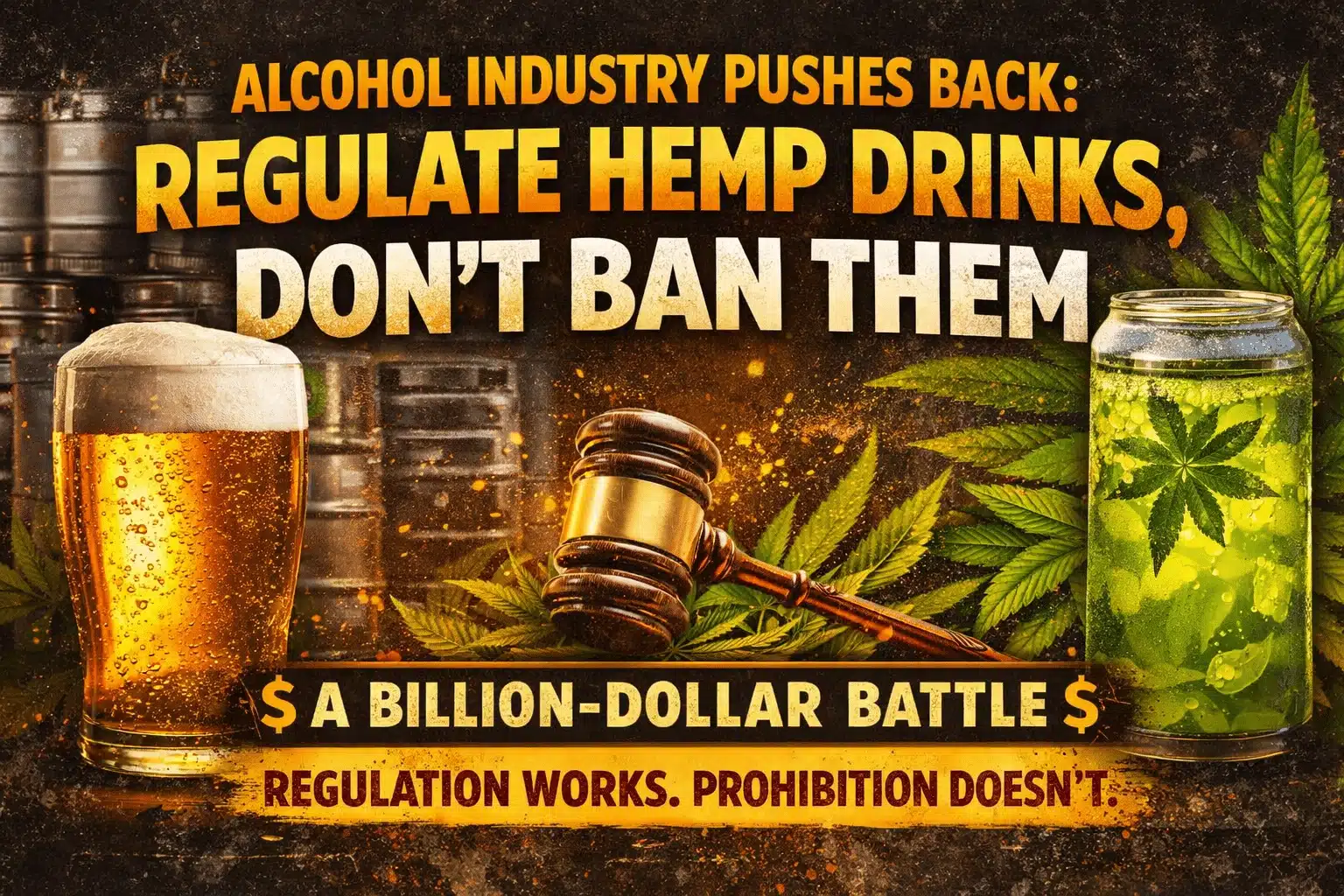
As lawmakers move closer to cracking down on hemp-derived THC products, the alcohol industry is stepping into the fight—and surprisingly, they’re not calling for prohibition.
Instead, a major alcohol trade group is urging Congress to regulate hemp THC beverages rather than ban them outright, arguing that a structured framework would protect consumers while preserving a fast-growing market.
The push comes as federal lawmakers consider policies that could effectively wipe out the booming hemp beverage sector, which has exploded in popularity as an alternative to alcohol.
Regulation Over Prohibition
The alcohol industry’s position is simple:
Set clear rules
Enforce age restrictions
Require testing and labeling
Treat THC drinks more like alcohol than contraband
Their argument? A ban won’t eliminate demand—it will just drive the market underground.
A Billion-Dollar Battle
Hemp-derived THC drinks have quickly become one of the hottest segments in cannabis, appealing to consumers looking for a legal buzz without alcohol. But that growth has also put a target on the industry’s back.
With federal changes looming—including tighter definitions of THC that could outlaw many current products—the stakes are massive.
The Bigger Picture
This isn’t just about drinks—it’s about the future of hemp itself.
Regulators want control
Lawmakers are split between bans and oversight Industries—from cannabis to alcohol—are jockeying for position
And now, even Big Alcohol is signaling something the hemp industry has been saying all along:
Regulation works. Prohibition doesn’t.
Bottom Line
As the fight over hemp intensifies, one thing is clear—this isn’t a fringe issue anymore.
When the alcohol industry starts lobbying to protect THC products, you know the game has changed.
Rapper turns police raid into music… and wins on free speech Afroman just proved something loud and clear:
You can turn a police raid into a hit song — and win in court.
The rapper, best known for “Because I Got High,” came out victorious in a defamation lawsuit filed by seven Ohio sheriff’s deputies after he used footage of a 2022 raid on his home in a series of music videos.
FROM RAID TO RECORD
The whole situation started when law enforcement raided Afroman’s house on suspicions of drug activity and kidnapping.
They came in heavy…
Guns drawn
House searched
Property damaged
And found nothing.
No charges. No arrests. No case.
THEN HE DID WHAT ARTISTS DO
Instead of staying quiet, Afroman flipped the script.
He took home security footage of the raid and turned it into content — dropping viral music videos, including tracks off his “Lemon Pound Cake” project.
One clip even shows an officer distracted by a cake sitting on the counter — a moment that became internet gold.
THE LAWSUIT
The deputies didn’t find it funny.
They sued Afroman for defamation, claiming:
He damaged their reputations
They faced harassment after the videos dropped.
They deserved millions in damages
(Reportedly close to $4 million.)
THE VERDICT
The court didn’t buy it.
A jury sided with Afroman, ruling that his videos and music were protected under free speech, not defamation.
After the win, Afroman summed it up in true fashion:
“We did it… Freedom of speech.”
WHY THIS MATTERS
This case hits bigger than one rapper.
It’s about:
Free speech vs. law enforcement power
Art as protest
Who controls the narrative after a raid goes wrong.
Afroman didn’t just defend himself — he turned the system into content… and beat it at its own game.
Our BLAZED TAKE
Let’s be real…
They kicked in his door, found nothing, and then got mad when he made a song about it.
That’s not defamation —
that’s storytelling.
And now there’s a legal precedent backing it up. It was absolutely hilarious watching him on the stand last week absorbing everything the DA threw at Afroman, as he stood there in his USA flag suit and sun glasses, and he leaned right back into the prossicuter, throwing body shots, 1st Ammendment, then 4th Ammendment.
As a monthly practitioner of the 1st amendment we are most proud of you Afroman and would love to get you on the podcast.
In early August 2025, over 50 Democratic members of the Texas House left the state—relocating to places like Illinois, New York, and Massachusetts—to deny Republicans the two‑thirds quorum needed to conduct legislative business. Their stated goal: block a proposed congressional redistricting map that would likely add five GOP seats ahead of the 2026 midterms .
Impact on HB 5 and SB 5: The Hemp THC Ban
The special legislative session, which began July 21 and runs through August 19, includes up to 18 items on the agenda, notably bills concerning hemp-derived THC regulation or outright bans. Among them:
Senate Bill 5 (SB 5): a renewed GOP effort to ban all consumable hemp products containing any detectable THC—allowing only CBD and CBG—raising the legal age to 21, and criminalizing possession with fines/jail time .
House Bill 5 (HB 5): a companion bill in the House targeting similar standalone enforcement .
Because no quorum exists in the House, these bills cannot advance, hearings are suspended, and the agenda for THC regulation is effectively frozen—as long as Democrats remain absent .
Why Now?
The Democrats argue that the redistricting map would disenfranchise urban and minority voters by redesigning districts to favor Republicans. HB 5 and SB 5 were secondary priorities in comparison—hence their decision to prioritize blocking the maps over THC legislation .
Political Fallout & Legal Threats
Governor Greg Abbott and House GOP leaders responded quickly: issuing civil arrest warrants, imposing $500/day fines per absent member, and threatening removal from office—based on a 2021 Attorney General opinion that legislators who abandon their duties may forfeit their office. Abbott and legislators have also hinted at possible felony charges tied to fundraising efforts supporting the walkout .
Legal experts emphasize these actions are largely symbolic unless lawmakers physically return to Texas: arrest warrants can only be enforced within state lines, and removal proceedings would likely face court challenges .
Broader Consequences
The disruption affects more than just hemp policy:
Flood relief and disaster recovery bills remain in limbo.
Other special session topics like education reform, bathroom bills, and property tax limits are paused. Even Governor Abbott retains the power to call additional special sessions if needed, which could reopen the debate over banning THC .
Redistricting Blocked until quorum restored
HB 5 / SB 5 (THC ban) – On hold; no quorum means no hearings or votes
Consequences for Democrats $500/day fines, arrest warrants, removal threats (symbolic if out of Texas)
Session deadline Ends August 19, though further sessions possible
Industry / Regulatory angle Advocates were pushing for regulation rather than outright ban; Democrats support age limits, potency caps, and safe packaging
What Happens Next?
As long as the Democratic lawmakers remain out of state, the special session—including debates on hemp-derived THC—remains effectively frozen. If lawmakers return or are forced back before August 19, it’s possible the ban legislation could resume. Alternatively, Abbott could reconvene lawmakers for another session if the end-of-session deadline is reached without action.
AUSTIN, Texas, July 22, 2025 – The Texas Hemp Business Council (THBC) today issued the following statement regarding the introduction of SB 5 during a special session of the 89th Texas Legislature:
“Some Texas lawmakers are once again ignoring the facts, the public and the governor.
“Despite Governor Abbott’s veto of SB 3 and overwhelming opposition from Texans, Lieutenant Governor Dan Patrick and Senator Charles Perry are now pushing SB 5, a reckless repeat that would ban federally legal hemp products, kill small businesses and criminalize responsible consumers, all under the false premise of public safety.
“Governor Abbott got it right the first time: banning hemp is bad policy and bad for Texas. His veto protected a $5.5 billion state industry that supports over 50,000 jobs and contributes $268 million in annual retail tax revenue.
“Texans have spoken loudly and clearly. With 150,000 petition signatures, 8,000 handwritten letters and three statewide polls, the message is the same: prohibition doesn’t work. What Texans want is smart, responsible regulation.
“That’s why THBC strongly supports HB 4242, a common-sense alternative that includes 21+ age limits, child-resistant packaging and setbacks from schools. It’s the right path forward for public safety, economic freedom and the future of hemp in Texas.”
About the Texas Hemp Business Council
The Texas Hemp Business Council is an industry organization dedicated to promoting the hemp-based cannabinoid industry in Texas, while advocating for consumer safety, education and stakeholder engagement. More information is available at http://www.texashempbusinesscouncil.com.
Eight-seven percent of Americans say that marijuana ought to be legal for either medical or adult use, according to nationwide polling compiled by the Pew Research Center.
The results are consistent with those of prior Pew polls finding that only about ten percent of US adults support a blanket policy of cannabis criminalization.
“The federal government’s ‘Flat Earth’ position on marijuana policy is remarkably out of step with both scientific and public consensus,” NORML’s Deputy Director Paul Armentano said. “Federally elected officials who refuse to take action to end cannabis criminalization do so at their own political peril.”
Fifty-four percent of respondents said that cannabis should be legal for both medical and adult use, while 33 percent of those surveyed supported medical marijuana legalization only. Consistent with prior polls, support for legalizing cannabis is strongest among liberal-leaning and younger voters (those ages 18 to 29), and it is weakest among more politically conservative-leaning voters and those over the age of 75.
Twenty-four states have legalized marijuana for adults and 40 states regulate medical cannabis access to qualified patients. Some 54 percent of Americans now reside in a jurisdiction where the adult-use cannabis market is legally regulated, while 79 percent live in a county with at least one marijuana dispensary.
Additional public opinion polling data is available from NORML.
Congress is moving quickly to redefine hemp in such a way that nearly all consumable
products will be banned.Senators are expected to vote THIS week on the appropriations package that includes
this language. We have successfully defeated these types of attacks on our lawful,
federally regulated industry before, and we will fight to do so again.
From farmers to consumers who use the products for health and wellness to the shop
owners who depend on the sales of products – we must make a lot of noise to stop this
attack on our industry.
Encourage your members of Congress to vote NO on hemp bans and instead sign onto
colleague letters that are advocating FOR and WITH the hemp industry by passing
robust regulations.


 Regulation Over Prohibition
 A Billion-Dollar Battle
 The Bigger Picture
 Bottom Line


